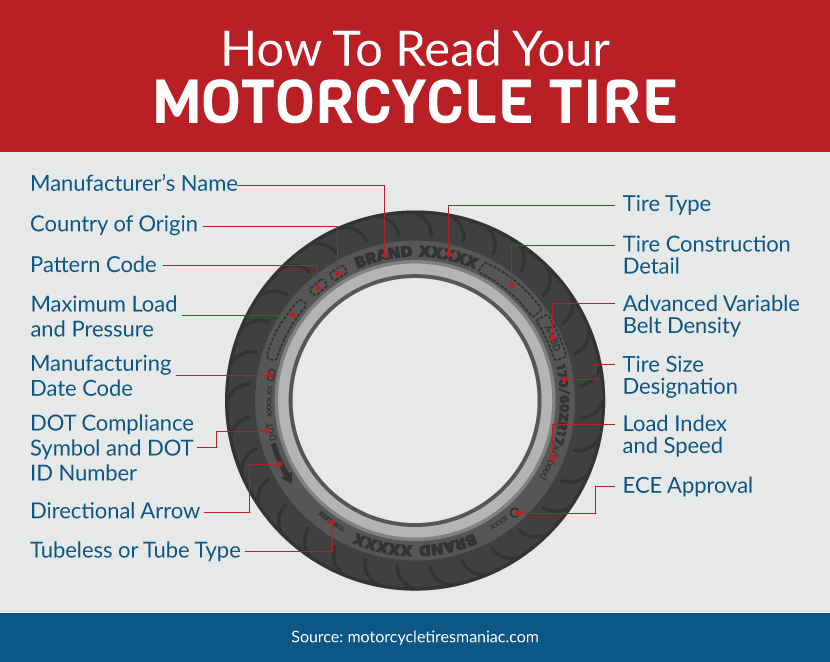
When it comes to understanding motorcycle tires, the alphanumeric codes etched into their sidewalls often seem cryptic, whispering tales of engineering precision and performance nuances. Take, for instance, the size designation “100/90-19″—a concise string that encapsulates a wealth of information about the tire’s dimensions, construction, and intended application. To the untrained eye, it’s just a sequence of numbers and a dash, but unraveling this code promises a deeper appreciation of your motorcycle’s handling dynamics and safety parameters. Delving beneath this nomenclature offers a shift in perspective, transforming these measurements from mere statistics to the very language of motorcycle performance.
The first component of the tire size, typically the three-digit number preceding the slash—in this case, “100”—indicates the tire’s nominal width in millimeters. This width dictates not only the contact patch your tire has with the road but also informs the tire’s potential stability and grip. A width of 100 mm is relatively narrow, common among standard and lighter motorcycles, enhancing maneuverability and agility, especially at lower speeds or on urban roads. Wider tires, conversely, confer greater straight-line stability and increased traction in corners but may impose compromises in weight and fuel efficiency. Understanding this width is crucial, as it calibrates a rider’s expectations regarding the bike’s handling characteristics.
Following the width is the aspect ratio, represented here by “90”, which expresses the sidewall height as a percentage of the tire’s width. Essentially, this number reveals the ratio of the tire’s sidewall height to its width—in this case, the sidewall height is 90% of 100 mm, or 90 mm tall. This measurement holds immense sway over ride quality and tire performance. A higher aspect ratio, indicating a taller sidewall, generally absorbs road irregularities better, yielding a cushioned ride. Conversely, lower aspect ratios suggest shorter sidewalls, enhancing lateral rigidity which translates to sharper cornering behavior and improved feedback to the rider. Grasping this relationship highlights how subtle changes in aspect ratio can revolutionize a motorcycle’s handling dynamics.
The final figure, “19”, denotes the diameter of the wheel rim in inches, which the tire is designed to fit. Rim diameter is a critical factor—affecting everything from the tire’s response to road feedback to the overall geometry of the motorcycle. A 19-inch rim, common in many standard and tourer motorcycles, strikes a balance between nimbleness and high-speed stability. Smaller diameters, like 16 or 17 inches, often lend themselves to sportier motorcycles, offering quicker throttle response, while larger diameters, such as 21 inches, favor off-road models, improving obstacle traversal and stability on uneven terrain. This dimension is not only about compatibility but also about the nuanced interplay between wheel size and vehicle dynamics.
Beyond these primary elements, a tire’s sidewall almost speaks an entire dialect of complexity through additional codes and symbols. Load index and speed rating, for instance, provide critical insight into the tire’s capacity and performance envelope. The load index numerically expresses the maximal weight the tire can safely carry, while the speed rating designates the maximum speed attainable under those load conditions. These codes are not mere technical details but paramount safety indicators. Ignoring them risks exceeding the tire’s design threshold, potentially culminating in catastrophic failure under demanding conditions.
Tire construction technology also subtly imprints itself within these markings. Radial tires, heralded by an “R” in the size code (e.g., 100/90R19), represent the prevalent construction type in modern motorcycles, characterized by layers of fabric cords arranged radially from the center of the tire. This design promotes superior handling, enhanced grip, and better heat dissipation compared to bias-ply tires, which possess angled cord layers. Radial construction also facilitates a wider tire footprint under load, contributing to better road contact and stability—advantages keenly appreciated by both riders seeking performance and those desiring longevity.
Understanding tire sizes becomes even more paramount when contemplating tire replacement or upgrades. Substituting a tire with a different size without considering the implications could markedly alter the motorcycle’s geometry, ground clearance, and even instrumentation accuracy. For example, installing a tire with a larger diameter affects the overall circumference, potentially skewing speedometer and odometer readings, and may raise the bike’s ride height, impacting handling and rider comfort. The delicate balance struck by the manufacturer’s recommended tire dimensions underscores the prescience of adhering to specified sizes or consulting professionals before deviating.
Another layer of intrigue comes from how closely tire dimensions interface with a motorcycle’s intended use and rider preferences. Cruiser motorcycles often favor wider rear tires with moderate aspect ratios to imbue stability and a commanding road presence. Meanwhile, sportbikes lean towards narrower, lower-profile tires prioritizing nimbleness and rapid directional changes. Adventure and dual-sport models tread a fine line with medium aspect ratios and larger rim diameters, balancing on-road agility with off-road resilience. This intricate balance between size, profile, and diameter fosters a rich tapestry of possibilities, allowing every rider to curate their machine’s character.
Moreover, the interplay between tire size and environmental conditions reveals the subtle science behind traction. Larger contact patches improve grip on smooth asphalt yet can be a disadvantage on loose or wet surfaces where narrower tires cut through debris more effectively. This dynamic proves pivotal for riders navigating varying terrain or climates, underscoring the tire’s role as a crucial liaison between rider intention and road response. The more proficient one becomes at decoding tire sizes, the better prepared they are to tailor their setups for peak safety and performance.
Every rider who glimpses that series of numbers gains access to a code that, once deciphered, unlocks a new understanding of their motorcycle’s capabilities. The seemingly straightforward “100/90-19” unfolds into a narrative of precision engineering, performance trade-offs, and safety imperatives. Every dimension conveys more than size—it whispers promises of how the motorcycle will feel beneath you, how agile or steadfast it might be, and how it will best survive and thrive amidst the challenges of the open road.
The next time you find yourself glancing at your motorcycle’s tires, remember: those figures are more than just numbers—they are an intimate dialogue between you and your machine. To comprehend this dialogue is to elevate your riding experience, to foster a connection forged through understanding, and ultimately, to unlock the full potential of the ride that lies ahead.