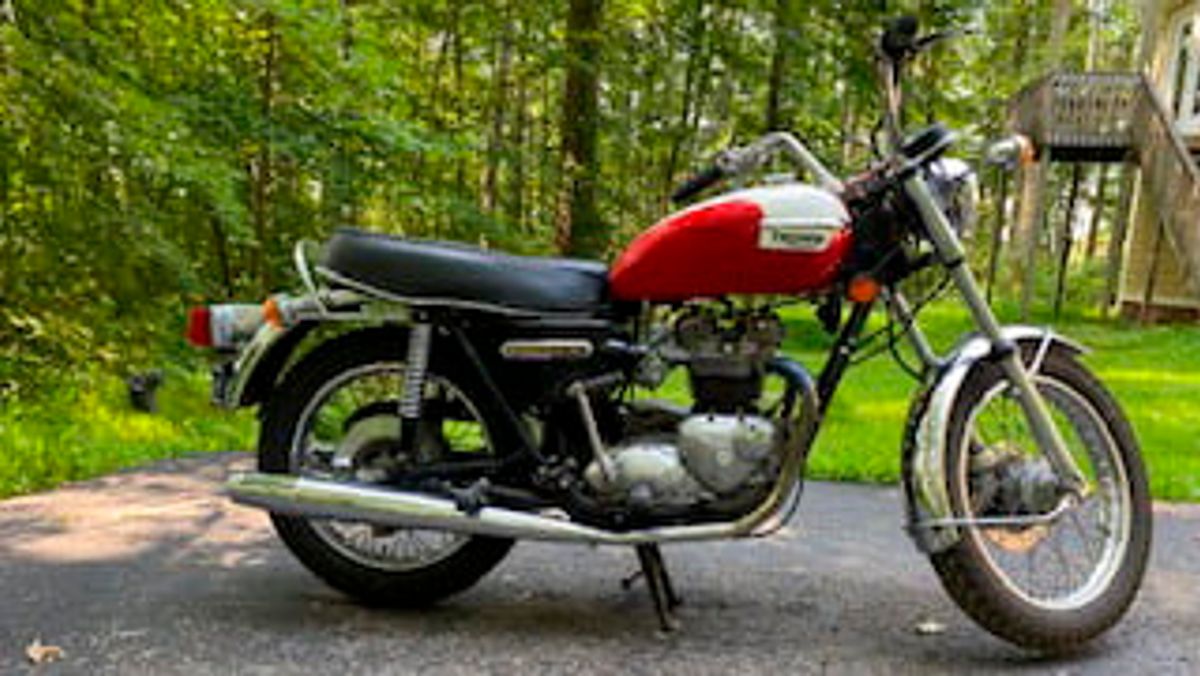
Is it possible that a motorcycle from nearly five decades ago can still ignite the same passion, evoke the same admiration, and deliver a riding experience as exhilarating as the machines of today? The 1976 Triumph Bonneville 750 challenges modern preconceptions about classic motorcycles, standing not merely as an artifact of British motorcycling history, but as a robust testament to engineering finesse and timeless design. This iconic model deftly balances nostalgia with performance, compelling enthusiasts and newcomers alike to reconsider what makes a motorcycle truly classic.
The 1976 Triumph Bonneville 750, born from the illustrious lineage of the Triumph Engineering Company, epitomizes the golden age of British motorcycling. At its core lies a 744cc air-cooled parallel-twin engine, a powerplant that embodies both brute strength and refined mechanical artistry. Unlike contemporary multi-cylinder beasts, the Bonneville’s twin-cylinder design delivers a distinctive character through its smooth power delivery and sonorous exhaust note, a soundtrack that summons the spirit of rebellious roadsters cruising the open highways of the 1970s.
One cannot discuss the Bonneville without highlighting its quintessential British styling. The aesthetic exudes an understated elegance punctuated by purposeful simplicity—from the chrome-laden fuel tank and twin round instruments to the distinctive dual exhausts sweeping along either side. The 1976 iteration in particular showcases subtle refinements that don’t scream for attention but rather whisper class to those with discerning eyes. This thoughtful design ethos invites admiration without ostentation, a concept increasingly rare in an era enamored with flashy embellishments.
But does its classic charm translate to practical road performance? The Bonneville 750 was engineered at a time when motorcycling was transitioning between raw mechanical grit and emerging sophistication. Equipped with a five-speed gearbox—an enhancement over its predecessors—it offered riders a broader spectrum of gears for varied terrain, an essential feature for both spirited city riding and lengthy countryside journeys. The suspension, comprising conventional telescopic forks and twin rear shocks, caters to comfort without sacrificing the nimble responsiveness that made the Bonneville a beloved road companion.
However, embracing a vintage machine like the 1976 Triumph Bonneville demands acceptance of certain compromises. Modern motorcycles boast advanced suspension technology, anti-lock braking systems, and electronic fuel injection. The Bonneville, in contrast, relies on tried-and-true mechanical simplicity. This raises a playful but inevitable question: can a classic bike, with its analog charm, stand up to the demands of today’s riders, both in terms of safety and amenity? Purists might argue that the answer lies not in technological supremacy but in the purity of connection between rider and machine — a connection less distracted by electronic aids and more focused on raw skill and mechanical intuition.
Speaking of challenges, maintaining a 1976 Triumph Bonneville requires an astute appreciation for its mechanical intricacies. Unlike modern motorcycles with diagnostic computers and modular components, the Bonneville is a testament to hands-on craftsmanship. Regular valve adjustments, carburetor tuning, and meticulous lubrication are part of the ownership ritual. This maintenance regimen might present a hurdle for the uninitiated but offers a rewarding opportunity to engage intimately with the machine’s anatomy. For many, this hands-on stewardship reinforces a profound bond, transcending mere transportation and elevating the experience to one of living heritage.
The ride dynamics of the Bonneville further accentuate its multifaceted personality. It carries a weight and balance that speaks to traditional British engineering. The low center of gravity combined with a relatively narrow profile empowers riders with agile handling through urban labyrinths as well as confidence on winding country roads. The torque-rich parallel twin delivers its power in a manner that invites playful acceleration rather than aggressive surging—a characteristic that transforms each ride into a leisurely dance between machine and asphalt.
It is also pertinent to understand the cultural resonance the Bonnie holds. In the 1970s, the Triumph Bonneville was intrinsically woven into the fabric of popular culture — favored by iconic figures ranging from Steve McQueen to The Who’s Pete Townshend. The 1976 model, arriving at the zenith of the brand’s pre-British Leyland era, carried forward this legacy, appealing to a spectrum of riders who valued both performance and style. Today, that cultural cachet endows the bike with an aura that transcends mechanical specifications; it becomes a rolling emblem of an era defined by youthful vigor and indomitable spirit.
For collectors and restoration aficionados, the 1976 Bonneville represents a compelling canvas. Many examples have been carefully preserved or meticulously restored to original condition, showcasing the enduring appeal of Triumph’s craftsmanship. The availability of aftermarket parts, combined with an enthusiastic global community, supports an ecosystem that ensures these machines remain roadworthy and relevant. Thus, the Bonneville continues not only as a relic for admiration but as a living, breathing participant in today’s motorcycling world.
The question remains though: in a landscape dominated by high-performance sportbikes, avant-garde electric motorcycles, and cutting-edge technology, can the 1976 Triumph Bonneville truly stake its claim as a viable, enjoyable mode of transport? Beyond the technical deliberations, the answer lies in the philosophy it embodies. It challenges riders to embrace simplicity, to revel in the unfiltered feedback of the road, and to appreciate the subtle artistry woven into every chromed surface and mechanical component. It invites a rejection of excess in favor of authenticity, a celebration of history felt kinetically beneath the seat.
In concluding this revisitation, the 1976 Triumph Bonneville 750 stands as more than just a motorcycle; it is a bridge linking past and present, a testament to British engineering heritage that continues to inspire. Its playful defiance of modern conventions presents both a challenge and an invitation: dare to ride different, and discover the timeless bliss of a classic British motorcycle that refuses to be forgotten in a world perpetually racing toward the future.