The 1997 Honda Valkyrie stands as an automotive marvel, a motorcycle that challenges traditional paradigms with its unique engineering prowess and performance sophistication. It’s a machine that commands attention not just for its bold styling but for the intricacies hidden beneath its muscular exterior—most notably, its flat-six engine configuration. This powerplant doesn’t merely promise raw power; it invites a fundamental re-examination of what cruiser motorcycles can achieve, fusing refinement, torque richness, and seamless delivery in a way that few others attempt.
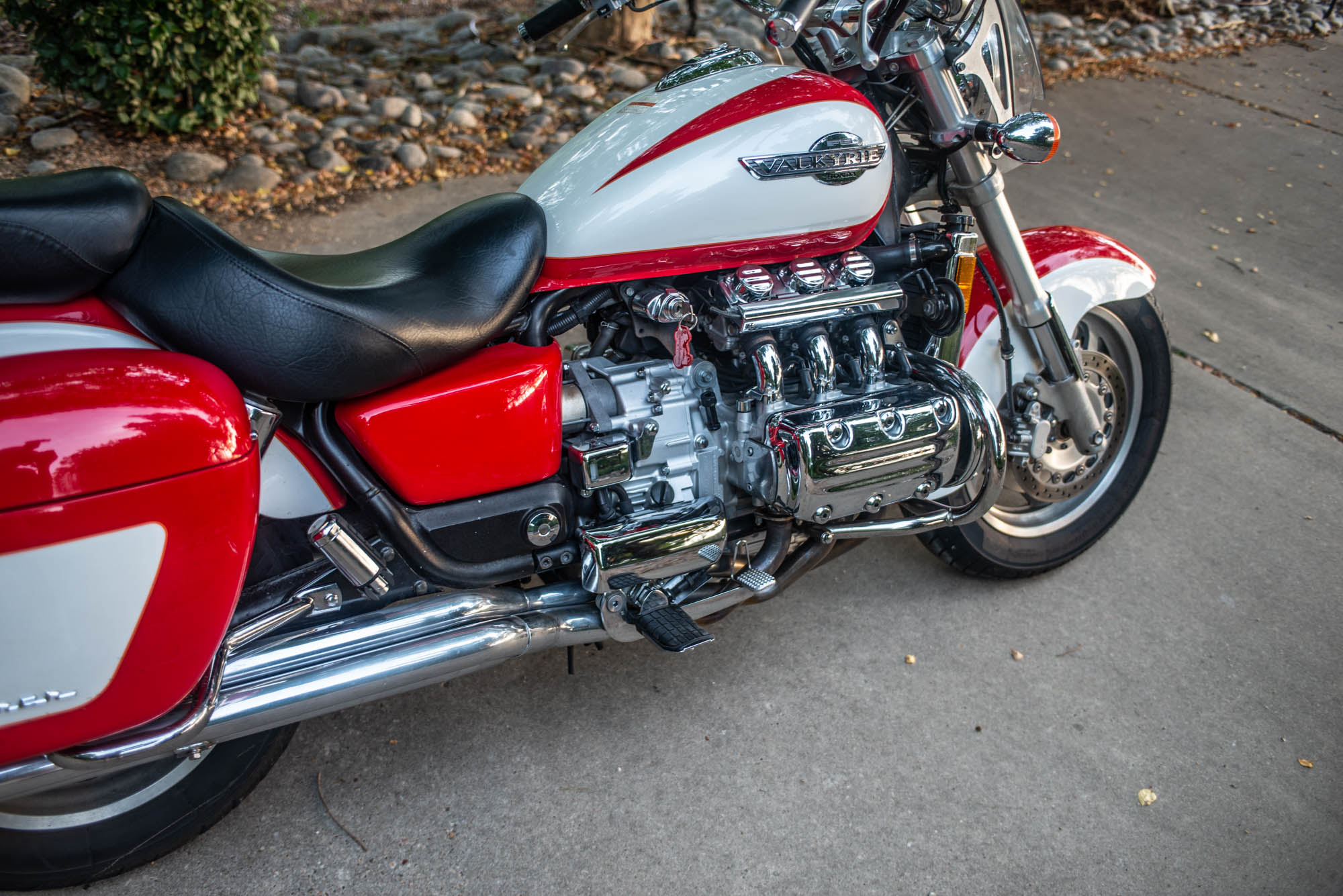
At the heart of the 1997 Honda Valkyrie lies a 1,520cc liquid-cooled flat-six engine, a design choice that immediately sets it apart in a sea of V-twins and inline fours. This horizontally opposed six-cylinder layout, often reserved for high-performance touring bikes and exotic machinery, provides a remarkably low center of gravity — a profound influence on balance and handling, especially for a cruiser that tips the scales at nearly 700 pounds. Unlike the conventional V or inline engines that dominate the cruiser category, the flat-six architecture offers a harmonic equilibrium, diminishing vibration to near imperceptible levels and delivering power with unprecedented smoothness.
The Valkyrie’s engine was, in essence, a masterstroke in reimagining a cruiser’s soul. Derived directly from the legendary Honda Gold Wing’s powerplant but liberated from the extensive fairings and touring accoutrements, this engine produced a stout 100 horsepower at 5,500 RPM and an impressive 100 lb-ft of torque at a leisurely 3,500 RPM. These figures are notable not only for the raw output but for the character of power delivery—flat, steady, and immensely tractable. Torque arrives early and remains consistently accessible, transforming the bike into an effortless cruiser on open highways and a surprisingly agile machine in urban canyons.
The flat-six engine’s design inherently promotes a broad and forgiving powerband. Each cylinder’s horizontal orientation allows for a perfectly symmetrical firing sequence that quadruples its ability to reduce secondary vibrations. From a rider’s perspective, this translates into an experience unmatched by competitors: acceleration feels smooth, predictable, and nearly uninterrupted by mechanical pulses typically felt in big V-twins. This refined character makes the Valkyrie a compelling option for enthusiasts yearning for power without the raw harshness endemic to other cruisers.
Fuel delivery on the 1997 Valkyrie was advanced for its time, utilizing six individual constant-velocity (CV) carburetors. This setup ensured precise metering for each cylinder, enhancing throttle response and overall engine efficiency. While carburetors might seem antiquated in an era leaning heavily toward electronic fuel injection, the chosen configuration reflects Honda’s commitment to delivering a pure mechanical experience, blending reliability with the ability to finely tune the engine’s characteristics. This synergy between design and function elevates rider engagement, allowing for nuanced control and an intoxicating connection with the machine’s mechanical heartbeat.
Accompanying the potent powertrain is a 5-speed transmission that provides both smooth shifts and robust durability. Honda crafted this gearbox to complement the wide torque curve, enabling seamless gear progression whether navigating city traffic or carving momentum through open roads. The transmission’s well-calibrated gear ratios enhance the Valkyrie’s cruiser DNA, emphasizing relaxed, confident riding rather than aggressive speed chasing.
Integral to the Valkyrie’s flat-six revolution is the chassis and suspension design that transcends typical cruiser conventions. The low-slung frame, built with a steel diamond configuration, balances the significant mass of the engine with a rigid yet forgiving architecture. Coupled with conventional telescopic forks upfront and dual shock absorbers at the rear—with pre-load adjustability—the bike manages to absorb road irregularities while maintaining precise handling characteristics. This marriage of weight and suspension ingenuity yields a ride that neither wallows nor stiffens excessively, creating an experience bordering on sporty without compromising cruiser comfort.
Honda’s innovative choice to house the flat-six engine transversely across the frame—unlike typical inline engines or V-twins—also affects the Valkyrie’s aerodynamics and cooling efficiency. The horizontally opposed cylinders protrude from both sides of the bike, allowing ample airflow and thermal dissipation. This positional advantage enhances engine longevity and consistent performance, even on long, demanding rides. Moreover, the visual impact of these cylinders flanking the rider adds to the Valkyrie’s distinctive presence, emphasizing mechanical artistry as much as functional design.
Performance metrics further underscore the Valkyrie’s place in cruiser history. The motorcycle’s 0 to 60 mph sprint happens in approximately 4.5 seconds, a figure that surprises many given the traditional association of cruisers with leisurely acceleration. The substantial torque available at low RPM allows for flexible throttle modulation, empowering riders to command the bike with gentle precision or assertive vigor as situations demand.
Beyond raw specifications, the 1997 Honda Valkyrie’s flat-six engine redefines the auditory landscape of cruisers. Unlike the typical thumping thud of V-twins that dominate the category, the Valkyrie exudes a unique sonic signature: a deep, rumbling growl underscored by a refined, melodic note from its six-cylinder harmony. This aural identity does more than announce presence; it creates an emotional connection, enhancing the riding experience with a soundtrack both primal and sophisticated.
In the context of motorcycle history, the 1997 Honda Valkyrie represents a deliberate departure from convention—an audacious experiment that sought to blend touring-grade engineering with cruiser ethos. Honda’s engineers took a gamble by transplanting the Gold Wing’s revered flat-six engine into a barebones, muscular cruiser frame. The result is a machine that invites reevaluation of the cruiser archetype’s limitations and possibilities.
In summary, the 1997 Honda Valkyrie stands as a testament to innovative powertrain design and meticulous craftsmanship. Its flat-six engine, with its inherent balance, smoothness, and potent torque, promises a shift in perspective for motorcycle enthusiasts. No longer confined by traditional V-twin dogma, the Valkyrie opens the door to a new breed of cruisers where mechanical elegance and brute strength coexist harmoniously. It’s a motorcycling experience that piques curiosity, challenges assumptions, and ultimately redefines what it means to command the road with sophistication and raw power.