The 1972 Harley-Davidson FX Super Glide is often heralded as the motorcycle that redefined the industry’s approach to customization and factory design. A tangible shift from tradition, the Super Glide boldly fused the classic elements of Harley-Davidson’s heavyweight motorcycles with a flair of personalized aesthetics straight from the factory floor. This seminal model marked a new dawn, where the lines between mass production and bespoke craftsmanship became intriguingly blurred, enticing riders with promises of individuality without the painstaking effort of aftermarket modification.
The genesis of the Super Glide is an intriguing tale of innovation born from the visionary mind of Willie G. Davidson, who endeavored to create a motorcycle embodying the spirit of the chopper but grounded in factory reliability and consistency. Prior to the Super Glide, Harley’s lineup was segregated between the heavy touring bikes and the smaller, sportier models. Custom motorcycles—choppers and bobbers—were the domain of enthusiasts and shops, pieces built painstakingly with distinct personalities. The Super Glide shattered this precedent by offering Harley’s first true “factory custom,” designed to captivate riders who sought a motorcycle with an edge yet didn’t want the vagaries or impracticalities of pure custom builds.
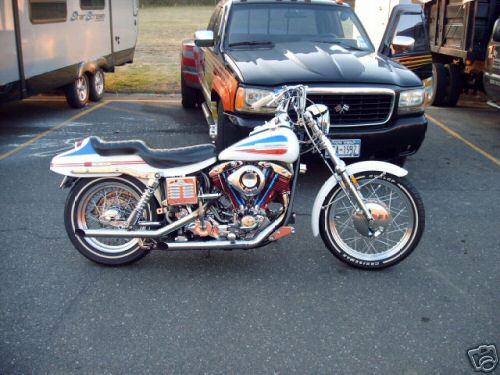
At its core, the 1972 FX Super Glide welded the frame and front end of the Sportster with the robust engine and swingarm of the big twin Electra Glide. This fusion delivered a bike that balanced agility with power, carving out a mid-sized niche between Harley’s heavy cruisers and lighter models. The combination was deceptively simple yet revolutionary—a motorcycle with the heart of a cruiser and the stance of a chopper. The signature wide front forks and twin discs lent a commanding presence, presaging the muscular style that would dominate Harley’s lineup in decades to come.

Underneath the iconic peanut-shaped fuel tank and sweeping fenders lurked the potent Shovelhead V-twin engine, a workhorse renowned for its formidable torque and aural personality. The 1200cc powerplant roared to life with a throaty growl that seemed to echo the rebellious spirit of the era. Coupled with a four-speed transmission, the Super Glide delivered an engaging riding experience—responsive, yet usable in everyday conditions. Unlike custom builds that might prioritize aesthetics over rideability, Harley-Davidson’s factory design ensured that the bike was as versatile on urban streets as it was on open highways.
What was equally captivating was the Super Glide’s bold styling—a marriage of contrasts that has since become a hallmark of Harley’s design DNA. The rigid rear frame replaced by a swingarm suspension meant for improved handling and rider comfort, departed from the chopper’s notoriously harsh ride, while still evoking that stripped-down, aggressive silhouette. The minimalist bodywork, low-slung stance, and chromed essentials imparted a raw yet refined quality, creating visual intrigue. This deft blend of form and function piqued the curiosity of motorcycle aficionados worldwide and ushered a newfound appreciation for the factory custom philosophy.
The Super Glide’s suspension and braking systems also reflected an advance in motorcycle engineering for its time. With telescopic forks and twin front disc brakes, it offered superior control and stopping power uncommon in Harley models of the era. This made for a confident ride that didn’t sacrifice performance beneath its street-inspired style. Such detailing delivered an experience that was both emotionally and mechanically satisfying—a rare duality that added to the motorcycle’s magnetism.
One cannot overlook the cultural impact of the 1972 Super Glide. Emerging at a crossroads when motorcycle culture was rapidly evolving, it resonated powerfully with a new generation of riders who craved authenticity and expression rooted in heritage. In many ways, the Super Glide became an icon of the 1970s, embodying freedom, rebellion, and the embrace of individuality—attributes long associated with Harley-Davidson but now articulated in a more accessible and modern guise.
Its introduction also set a marketing precedent that continues to influence Harley-Davidson’s approach. The factory custom concept tapped into the increasing demand for motorcycles that reflected personal style without forfeiting warranty or reliability. This balance proved prescient, presaging the surging popularity of customized bikes decades later and cultivating a loyal customer base that valued innovation paired with tradition.
While many purists initially balked at the idea of a factory custom, fearing it diluted the essence of hand-built individuality, the Super Glide gradually won over critics with its undeniable charisma and dynamic capabilities. It was a motorcycle that dared to challenge conventions and invited riders to reconsider their definitions of customization, performance, and style.
In retrospect, the 1972 FX Super Glide was more than just a motorcycle—it was a paradigm shift. It promised a new lens through which to view motorcycling; one where the factory could be a source of creativity rather than constraint. Its legacy endures in every Harley-Davidson model that carries a hint of customization straight from the assembly line, each echoing the daring innovation of the original Super Glide.
Ultimately, the 1972 Super Glide represents a captivating fusion of heritage and innovation, a bold statement that reshaped the motorcycling landscape. It is an invitation to explore how tradition can be reinterpreted without losing its soul. Riding a Super Glide is not merely about transportation—it is an experience steeped in history, style, and an enduring promise of freedom on two wheels.