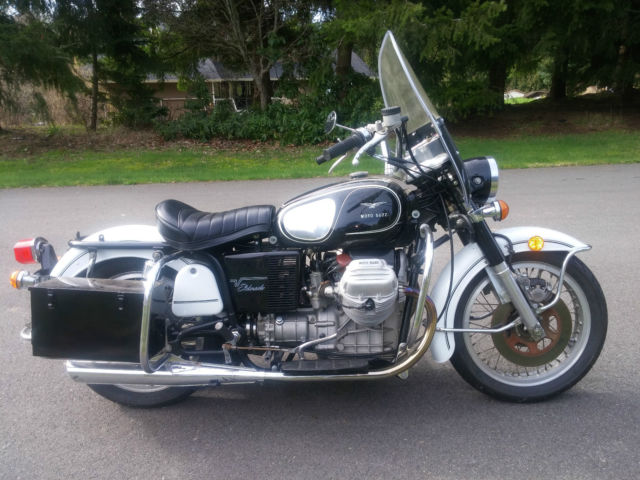
What if a motorcycle could embody both the rugged spirit of Italian craftsmanship and the relentless demands of law enforcement duty? The 1973–1974 Moto Guzzi Eldorado, famously known as the Police Bike Legend, rises as a tantalizing example of this fusion. Not merely a mode of transportation, but a mechanical emissary designed to patrol, pursue, and perform under pressure. Its presence is a testament to Moto Guzzi’s ingenuity during an era when motorcycles had to prove their mettle not just on open roads, but in the high-stakes scenarios unique to policing.
To understand why the Eldorado became more than just a motorcycle, one must delve into its origins. Moto Guzzi, an esteemed Italian motorcycle manufacturer renowned for their innovation and durability, harnessed their engineering brilliance to craft a model that stood apart in the early 1970s. The Eldorado was conceived to bridge the gap between power, reliability, and comfort—essentials for a police motorcycle expected to endure long shifts and rapid apprehensions.
The design of the 1973–1974 Eldorado was marked by its sharp yet utilitarian silhouette. Sporty lines merged gracefully with functional features, creating a machine that visually demanded authority. Its 850cc V-twin engine, a hallmark of Moto Guzzi’s mechanical soul, propelled the bike with a robust torque that delivered seamless acceleration. This wasn’t just about top speed; it was about responsiveness, the kind that law enforcement officers desperately needed when seconds could mean the difference between capture and escape.
Curiously, what elevated the Eldorado beyond its contemporaries was its unique approach to combining comfort with resilience. Police officers often spend hours in the saddle, necessitating ergonomics that could mitigate fatigue without sacrificing control. The Eldorado answered this challenge with an expansive and well-padded leather saddle, coupled with forward-positioned footpegs that allowed for a natural riding posture. But did Moto Guzzi manage to create a motorcycle that could slice through the tension of endless patrol hours without succumbing to weariness? Evidently, the answer lies in the bike’s sustained popularity among multiple police departments.
The 1974 model year heralded subtle yet significant improvements over its predecessor. Refinements in suspension and braking increased both stability and safety—a non-negotiable in the world of law enforcement where surprise pursuits could explode at any moment. The dual-disc braking system exemplified cutting-edge technology for its time, offering officers rapid stopping power that could be trusted on slick urban surfaces or unpredictable highway curves. Imagine an officer weaving through congested city traffic, relying unwaveringly on a nimble braking mechanism to avert catastrophe. This precision engineering underscored the Eldorado’s commitment to operational excellence.
Yet, with all these virtues, one might wonder what challenges the Eldorado faced in the competitive landscape of police motorcycles, particularly against the backdrop of American and British manufacturers who dominated law enforcement markets. The question isn’t trivial. With motorcycles like the Harley-Davidson Electra Glide commanding a significant part of the police fleets, Moto Guzzi’s Eldorado had to assert itself not just through specifications, but through reliability and user experience.
The answers arrived in the form of longitudinal crankshaft layout and shaft drive technology—a combination that drastically reduced drivetrain maintenance and enhanced durability. Unlike chain-driven motorcycles that frequently required adjustment and lubrication, the Eldorado’s shaft drive was almost maintenance-free, a boon for police departments managing extensive equipment inventories. This mechanical quirk, almost poetic in its engineering elegance, was part of what endeared the bike to officers who appreciated a motorcycle that spent less time in repair shops and more time on the road.
Beyond its mechanical prowess, the Eldorado possessed an unmistakable aura—one infused with character and prestige. These motorcycles weren’t just tools; they were symbols. When patrolling the streets, the unmistakable growl of the V-twin engine turned heads, signaling both authority and Italian finesse. The bike’s chrome accents gleamed under city lights, amplifying its commanding presence. Officers riding the Eldorado stood as embodiments of both tradition and progress, entrusted with a machine that combined heritage with modernity.
Taking a deeper dive, the Eldorado’s instrumentation panel itself reflected Moto Guzzi’s dedication to rider kinesthesia. Gauges were precisely placed for quick glances, revealing speed, fuel levels, and engine temperature with intuitive clarity. This minimized distraction and maximized situational awareness—a crucial factor during high-speed pursuits or emergency response where every millisecond counts. Was this level of rider-centered design common at the time? Not quite, highlighting Moto Guzzi’s forward-thinking approach in motorcycle ergonomics.
Interestingly, the Eldorado’s legacy extends beyond its active years in law enforcement. Vintage motorcycle collectors and enthusiasts now revere this model as a crown jewel within Moto Guzzi’s storied history. Restored examples are often showcased at prestigious rallies and exhibitions, admired not only for their aesthetic beauty but also for their technological significance. They evoke nostalgia for an era when motorcycles were simpler yet profoundly purposeful machines. It prompts the question: do today’s police motorcycles possess the same character and soul as the Eldorado did? The answer to that might be subjective but certainly fuels passionate debate among aficionados.
Furthermore, the Eldorado model helped pave the way for Moto Guzzi’s subsequent developments in both civilian and specialized motorcycles. Its engineering milestones served as a foundation to advance performance and durability, influencing designs that followed. To this day, the longitudinal V-twin configuration remains a signature trait of the brand, a lineage traceable to the Eldorado’s pioneering spirit.
In summation, the 1973–1974 Moto Guzzi Eldorado stands as much more than a relic of police enforcement—it is a legend encapsulated in steel, leather, and tire tracks laid across diverse landscapes. It challenges us to reconsider how we measure the success of a motorcycle: not just by its specifications, but by its ability to fulfill a high-stakes mission with poise and reliability. Could any modern model replicate the Eldorado’s perfect amalgamation of engineering grace and operational toughness? That remains a challenge the motorcycle world continues to ponder. Until then, the Eldorado rides eternally in the annals of motorcycle lore, a steadfast icon of law enforcement history and Italian motorcycling excellence.