The allure of the 2-stroke engine has captivated engineers, racers, and enthusiasts for decades, owing largely to its distinctive approach to power generation. Unlike its 4-stroke counterpart, the 2-stroke engine embraces a more compact and efficient cycle, completing power strokes at twice the frequency within the same crankshaft revolution count. Central to this efficiency is the intricate design and function of the ports—those meticulously sculpted apertures within the cylinder walls. These ports govern the flow of fuel-air mixture and exhaust gases, orchestrating a symphony of fluid dynamics that directly influences power output, throttle response, and overall engine behavior.
Understanding how 2-stroke ports operate reveals why these engines sustain such a fervent following despite challenges in emissions and fuel efficiency. The fascination often begins with the unmistakable sound and throttle response but deepens as one unravels the underlying mechanical choreography that transforms simple reciprocation into an explosive burst of power.
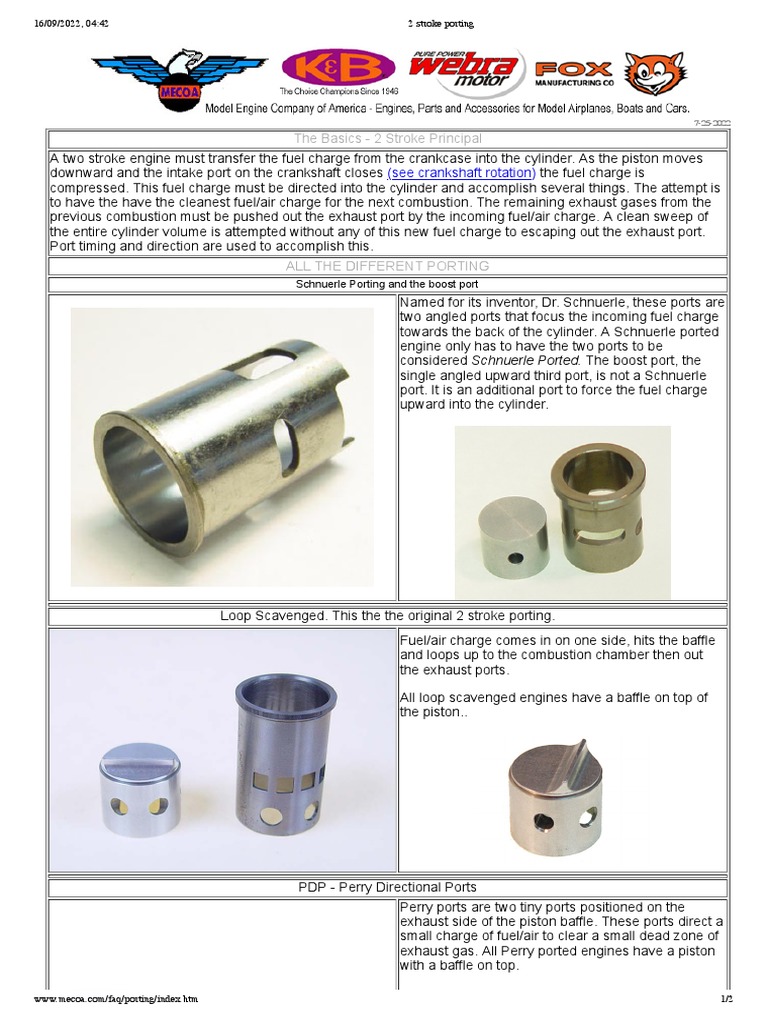
The heart of the 2-stroke engine’s breathing system is its porting geometry. Unlike four-stroke engines equipped with valves timed mechanically to open and close, 2-strokes rely on the piston itself to modulate port exposure. As the piston reciprocates, it alternately uncovers and covers intake, transfer, and exhaust ports, creating a transient but critical window for gas exchange.
At the bottom of the cylinder lies the intake port, often integrated into the crankcase. When the piston ascends, it increases volume in the crankcase, drawing in a fresh air-fuel mixture through the reed valves or rotary valve assembly. The subsequent downward stroke compresses this mixture, forcing it through the transfer ports into the combustion chamber above. This energized flow drives the scavenge process—whereby exhaust gases are expelled and replaced by a fresh charge.
Transfer ports are strategically positioned and shaped to ensure optimal scavenging. Their angles and sizes dictate not only the velocity of the incoming mixture but also the degree to which fresh charge displaces residual burnt gases. Engineers often employ techniques like deflector pistons or sculpted port walls to direct the incoming mixture upward, forming a swirling motion that improves cylinder filling and prevents fresh mixture from escaping prematurely through the exhaust port—a phenomenon known as “short-circuiting.”
The exhaust port, situated on the opposite side of the cylinder, plays an equally pivotal role. When the piston descends past this port, high-pressure exhaust gases—byproducts of the combustion event—exiting the combustion chamber find their release. The timing and duration of exhaust port exposure, known as “port timing,” are crucial variables. They determine when the engine vents its gases and how efficiently this exhaust is scavenged, impacting power delivery characteristics.
High-performance 2-stroke engines often incorporate expansion chambers and specially tuned exhaust systems. These components leverage pressure wave dynamics to enhance scavenging efficiency. As exhaust gases depart, pressure waves reflect back from the expansion chamber, effectively pushing any escaping fresh mixture back into the cylinder just before the exhaust port closes—bolstering volumetric efficiency and, consequently, power output.
Within this elaborate exchange lies the allure of port timing and port shape customization, which enthusiasts and engineers manipulate to tune engines for specific performance envelopes. Extending the duration a port remains open can increase peak horsepower but often at the sacrifice of low-end torque and fuel economy. Conversely, shorter port timing improves tractability and efficiency but limits top-end power. This tunability lends 2-stroke engines a remarkable versatility, adaptable from dirt bikes darting through rugged terrain to sleek maritime applications requiring sustained high-rpm output.
Surface finish and port contour also command significant attention. The microscopic texture of port walls influences airflow friction and fuel droplet condensation. A mirror-smooth surface encourages laminar flow, minimizing turbulence and resistance, while a textured, matte surface can induce micro-mixing, promoting better atomization of fuel in the intake charge. Port shaping, such as bell-mouth entries, also aids in reducing flow separation and energy losses, further refining the efficiency of the induction process.
Fascination with 2-stroke porting persists because it embodies an intersection of art and science. Each port is a canvas upon which fluid dynamic principles, thermodynamics, and mechanical engineering converge. The dynamic interplay of gas velocities, pressure gradients, and timing transforms a seemingly simplistic design into a sophisticated mechanism capable of remarkable power density relative to its weight and size.
Moreover, understanding 2-stroke porting unveils the delicate balance between maximizing power and controlling emissions. Traditionally, 2-strokes have grappled with unburned hydrocarbons escaping through ports during scavenging. Modern advancements in port timing, exhaust design, and fuel injection seek to mitigate these drawbacks while respecting the engine’s inherent advantages. This evolution continues to spur curiosity and innovation within the realm of small engine technologies.
In essence, the 2-stroke port system epitomizes a microcosm of engine dynamics where geometry and timing converge to orchestrate an efficient yet powerful cycle. The ports serve as valve-less gateways choreographed by the piston’s passage, modulating the exchange of gases in a rhythm that balances power, efficiency, and mechanical simplicity. This intricate mechanism explains not only how a 2-stroke engine makes power but also why it maintains an enduring mystique among those who seek performance in its purest form.
Ultimately, the study of 2-stroke ports offers a window into a timeless engineering marvel. As each port opens and closes within fractions of a second, it encapsulates a process that marries rapid motion with precise control—fueling not just the engine, but the enduring passion for mechanical elegance in motion.