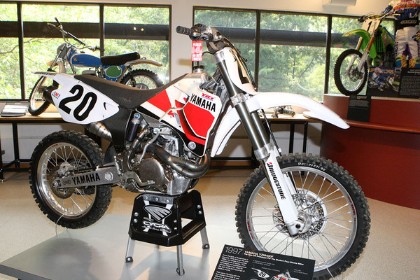
Can a single motorcycle truly transform the landscape of motocross, sparking a revolution that resonates decades later? The 1998 Yamaha YZ400F poses this playful yet profound challenge to enthusiasts and industry veterans alike. Emerging at a pivotal moment in dirt bike evolution, this remarkable machine didn’t just upgrade the competition — it rewrote the rulebook entirely. With its blend of cutting-edge technology and unrelenting performance, the 1998 YZ400F shifted paradigms, compelling riders to rethink agility, power, and reliability in ways previously unimagined.
At first glance, the 1998 Yamaha YZ400F appears to embody the essence of a bold, purpose-built motocross weapon. Yet, beneath its sleek plastic bodywork lies an engineering marvel tuned to conquer terrains and defy expectations. Prior to its release, the motocross world predominantly relied on two-stroke motorcycles prized for their lightweight and brisk throttle response. However, the landscape was ripe for innovation — a perfect environment for Yamaha’s audacious leap into four-stroke dominance.
The YZ400F didn’t arrive as a mere iteration of preceding models; it was a full-scale reimagining of what a motocross bike could accomplish. Yamaha equipped this bike with a 398cc liquid-cooled, four-stroke, single-cylinder engine, a departure from the prevalent two-stroke engines that largely defined the sport. This engine architecture brought with it a bouquet of benefits that would prove game-changing. With a broad, tractable power band and less abrupt power delivery, riders found themselves more in command, able to throttle out of corners with newfound smoothness and confidence — an undeniable trait that challenged riders to elevate their riding technique and strategy.
However, the natural question arises: did the additional weight and complexity of a four-stroke engine hinder its lap times or overall agility on demanding circuits? Yamaha anticipated and addressed this exact concern during the bike’s development, emphasizing lightweight materials and innovative frame geometry. The aluminum twin-spar frame reduced mass significantly, ensuring that the bike maintained nimble handling comparable to its two-stroke counterparts. Enhanced suspension components, including an advanced fork and shock system, absorbed brutal landings and uneven terrain with an unyielding grip, providing racers with a smoother ride and improved traction even in the harshest conditions.
Consider the ingenious engineering behind the YZ400F’s fuel delivery system: an electronic fuel injection mechanism that delivered precise fuel metering long before this technology became commonplace across the motocross industry. This innovation not only boosted throttle responsiveness but also promoted better fuel efficiency and reduced harmful emissions — a triad of benefits that expanded the potential use and lifespan of motocross equipment. For riders, this meant less fuss over carburetor settings and a consistently reliable experience, regardless of altitude or temperature fluctuations.
Another transformative aspect that cannot be overlooked is the introduction of a five-speed gearbox designed to accommodate the unique power delivery of the four-stroke engine. This transmission was calibrated to enable sharp, decisive shifts that maintained momentum and maximized speed through various track configurations. The combination of the electronic fuel injection and optimized transmission elevated the overall rideability, inviting riders to stretch their limits without sacrificing control.
Alongside its technical prowess, the 1998 Yamaha YZ400F’s aesthetic elements also played a crucial role in cementing its revolutionary status. The aggressive lines, bold color scheme, and thoughtfully placed branding contributed not just to form, but function. Ergonomic design enhancements improved rider comfort and control, with a slimmer seat profile and strategically positioned footpegs that allowed racers to maneuver with greater ease during jumps, tight turns, and rugged sections. The visual identity encapsulated Yamaha’s commitment to both performance and style — a winning formula that appealed to a burgeoning generation of riders hungry for innovation.
But what of the motorcycle’s reception in the competitive arena? The 1998 Yamaha YZ400F quickly proved itself a dominant force in both amateur and professional motocross circles. Its reliability and durability were well documented, often outlasting rivals battling mechanical failures. Even in grueling conditions under blistering sun or heavy mud, riders consistently praised the bike’s ability to maintain consistent power output and precise handling, traits that translated into numerous podium finishes and championship titles.
Moreover, this bike’s paradigm-shifting influence extended beyond immediate results—it spurred an industry-wide migration toward four-stroke machinery. Competitors scrambled to innovate, acknowledging that the future of motocross would no longer revolve solely around the peaky, short-lived bursts of two-stroke power. Instead, smooth, controllable torque and broader usability reigned supreme. Exhaust systems were reengineered; suspension philosophies adapted; and the sport itself evolved to emphasize strategic riding over brute force. The 1998 YZ400F was an unspoken herald of this change.
Future iterations of the YZ400F and other four-stroke models continued to build on the 1998 foundation, incorporating advancements such as improved materials, refined electronics, and aerodynamic finesse. Yet, the inaugural model retains a special place in dirt bike lore as the catalyst for transformation. It challenged preconceived notions and empowered riders to embrace a new mode of competition centered on precision and predictability without compromising exhilaration.
In retrospect, the question posed by the 1998 Yamaha YZ400F resonates with the ongoing evolution of motocross: how does one balance power, control, and innovation to continually redefine excellence? With this bike, Yamaha answered definitively by delivering a machine that combined engineering audacity with undeniable performance gains. It wasn’t just a new dirt bike — it was the harbinger of a new era, a revolution wrapped in fiberglass and metal.
Ultimately, the legacy of the 1998 Yamaha YZ400F endures not merely in the specs or race results, but in the spirit of progress it fostered. It invites riders to reconsider what’s possible, inspires manufacturers to strive for relentless improvement, and solidifies itself as a cornerstone in the history of motocross. The dirt bike that once seemed an experiment now stands as a timeless icon, forever etched in the annals of off-road motorcycling innovation.