The 1914 Iver Johnson Twin stands not merely as a relic from the dawn of motorcycling but as a living testament to an era when ingenuity and craftsmanship converged to birth modern two-wheeled freedom. This motorcycle, sometimes whispered of as one of the first in the evolving pantheon of motor vehicles, carries with it the romantic mystique of early twentieth-century mechanical exploration. Like a coiled spring of untapped potential, it captures the restless spirit of innovation that catapulted mankind from horse-drawn carts into the age of combustion engines and roaring engines slicing through the air.
At a glance, the 1914 Iver Johnson Twin appears to be an elegant chimera of form and function. The sleek contours of its frame, gracefully merging steel tubes into a lattice of strength and simplicity, evoke the architectural finesse of a bygone industrial renaissance. This motorcycle does not merely ride the road; it commands it with a palpable presence—as if it were a midnight stallion tamed for the metallic age. The artful integration of its twin-cylinder engine is a focal point, a mechanical heart pounding rhythmically with the promise of untold adventure and uncharted horizons.
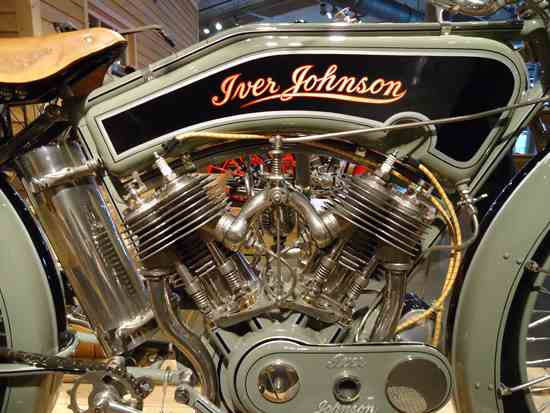
Delving deeper into the mechanical symphony that powers the Iver Johnson Twin, one finds a twin-cylinder engine that was considered revolutionary for its time. Unlike its singular contemporaries, this dual powerplant was akin to a duet, the pistons moving in concert to generate a smoother, more balanced surge of torque and speed. The rhythmic thrum of these twin cylinders was a siren call to early motorcyclists, signaling a new epoch in performance and reliability—a marked departure from the skeletal, often temperamental machines that preceded it.
Its engine was not just an assembly of metal and moving parts but a manifesto of engineering foresight. The elongated cylinders, meticulously cast and polished, reflected a commitment to durability and efficiency. The compact juxtaposition of the carburetors and exhaust pipes created a harmonious balance of power and poise, elevating the Iver Johnson Twin beyond mere transportation to a kinetic sculpture woven from iron and ambition. This intricate interplay between structural elegance and mechanical potency renders the motorcycle a marvel of early motor engineering.
However, the 1914 Iver Johnson Twin’s appeal extends beyond its technical specifications. It resonates culturally, echoing the spirit of a generation that dared to redefine adventure and autonomy. Riding such a machine was an act of defiance against the static constraints of the past—each mile covered was a stanza in the poem of progress. The motorcycle became an extension of the rider’s will, a metallic steed galloping through the tapestry of early American roads and landscapes, punctuated by the distant hum of industry and the call of open air.
The motorcycle’s design itself is a marriage between utility and artistry. The exposed chain drive, the minimalist yet purposeful fenders, and the ergonomic saddle designed for comfort during long, arduous journeys reflect the pioneers’ understanding of both human and mechanical needs. The crisp lines of the handlebars and the poised positioning of the footrests invite the rider into an intimate dance with the machine. It is as though the motorcycle anticipates the rider’s every nuance, responding with an almost sentient grace.
Moreover, the cultural context surrounding the 1914 Iver Johnson Twin reveals a fascinating narrative of early American motorcycling ethos. This was an age when motorcycles transcended their utilitarian roots to become symbols of freedom, rebellion, and modernity. The Twin’s relatively advanced engineering for its time positioned it among the elite class of motorcycles that bridged the gap between horse-powered tradition and mechanized velocity. Its presence on the roads was both a statement and a promise—a herald of the transformative power of technology fused with human ambition.
Collectors and historians often regard the Iver Johnson Twin as a crown jewel in the pantheon of motorcycling history. Its rarity, combined with its distinctive engineering features, makes it an object of obsession and reverence. Preserved examples become portals to a world where the clatter of pistons and the scent of burning fuel ignite imaginations and fuel narratives about the genesis of motorized mobility. The motorcycle epitomizes how mechanical innovation can serve as a mirror reflecting societal evolution and individual aspiration.
In many ways, the 1914 Iver Johnson Twin is a metaphorical lighthouse standing firm at the shores of human progress. It illuminates the pathway from raw invention to refined mastery, guiding subsequent generations of engineers, designers, and riders along a continuum of upward innovation. Each curve and contour echoes the hands that crafted it, each vibration tells stories of long journeys and the relentless pursuit of motion. It is a tangible embodiment of a moment when technology began to free humanity from the restraints of time and space.
Ultimately, the allure of the 1914 Iver Johnson Twin is steeped in a blend of nostalgia, technical marvel, and cultural symbolism. It is not simply a motorcycle but rather a narrative engine, capable of transporting the observer beyond the mechanical into realms of history, art, and human endeavor. To witness its form is to glimpse the very dawn of motorcycling, where the boundaries between man and machine blurred into a thrilling, primal unity. Like a phoenix born from steel and fire, the Iver Johnson Twin continues to soar through the annals of motorcycling lore, forever one of the first and forever iconic.