In the pantheon of motorcycling legends, few machines possess the raw, untamed spirit embodied by the 1974 Yamaha RD350. Like a comet blazing through the night sky, this two-stroke marvel carved a luminous path across the landscape of performance motorcycles, forever etching its name into the annals of speed and agility. The RD350 was not merely a vehicle; it was an elemental force—a symphony of violent acceleration and feather-light handling that beckoned riders to embrace the exhilarating paradox of control and chaos.
At the heart of the RD350 lies a powerplant that thrives on the mercurial nature of the two-stroke engine. Unlike the more subdued four-stroke counterparts of its era, the RD350’s 347cc parallel-twin delivered a crescendo of power and torque in a narrow, tantalizing power band. It was a relentless surge that could be likened to a finely-tuned predator, waiting patiently before unleashing its fury with surgical precision. This was no timid commuter; the RD350 was a rocket strapped to a razor-thin chassis, offering an intoxicating blend of speed and responsiveness.
The engine’s reed valve induction further refined its character, enabling crisp throttle response and an intoxicating bark from the exhaust pipes. Each twist of the wrist invited a symphony of mechanical poetry, with the exhaust note oscillating between a raucous growl and a high-pitched wail, echoing through canyons and city streets alike. The rapid firing order delivered a pulse that was not just heard but felt deeply within the diaphragm, an aural reminder of the raw energy coiled beneath the minimalist fairings.
The RD350’s chassis was a masterpiece of ethereal lightness and structural integrity. Yamaha’s engineers achieved a finely balanced architecture, marrying the nimbleness of a lightweight frame with the robustness necessary to harness the engine’s unyielding vigor. At a time when many motorcycles felt ponderous and sluggish in tight corners, the RD350 danced through bends with balletic agility. It was a breath of fresh air in an era defined by bulkier and heavier machines. Every lean and flick was a dialogue between rider and machine, an intricate ballet where the boundaries between the two blurred seamlessly.
Suspension components, though rudimentary by modern standards, provided an unexpectedly supple ride. The telescopic forks at the front and twin shock absorbers at the rear were tuned to complement the bike’s high-revving nature, soaking up imperfections on the road with surprising efficacy. Braking, courtesy of drum brakes at the front and rear, might appear antiquated today but delivered sufficient stopping power when wielded judiciously. The tactile feedback communicated through the brake lever was direct and honest, reinforcing the rider’s connection to the tarmac.
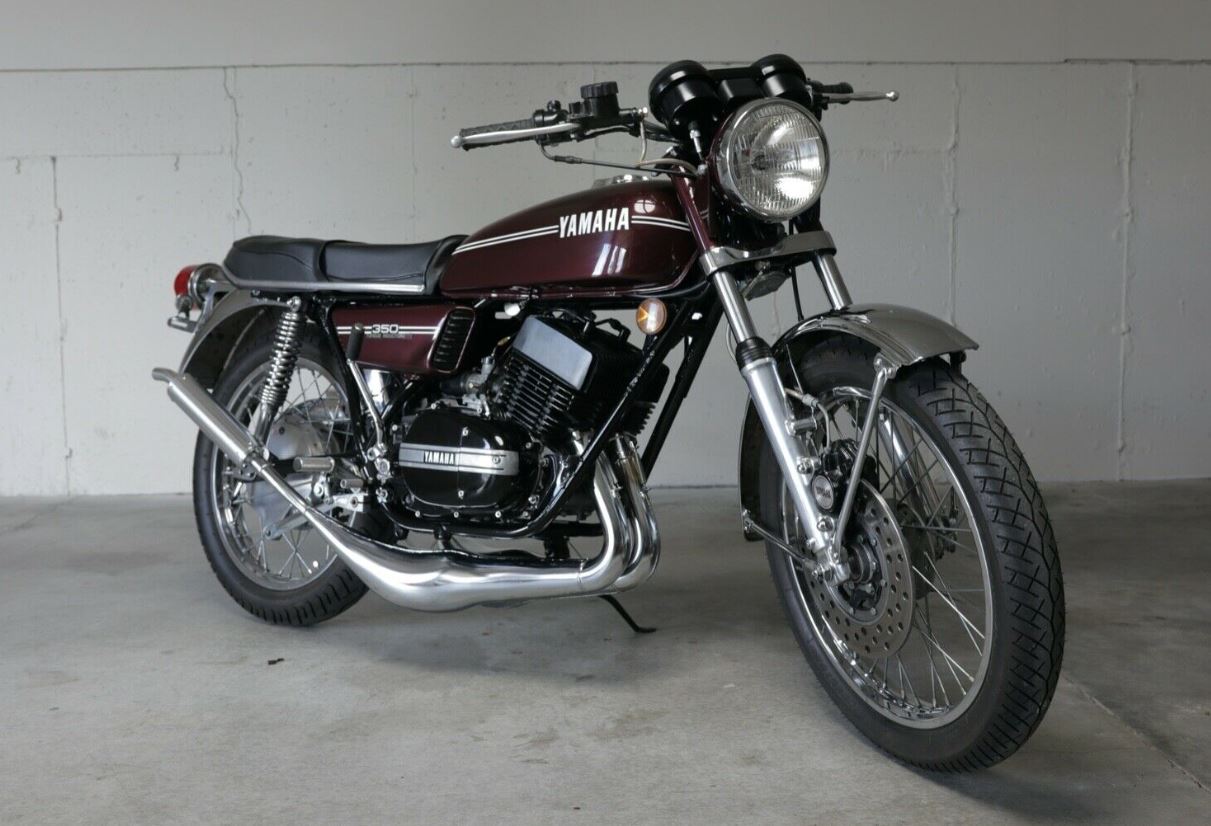
The aesthetic allure of the 1974 Yamaha RD350 cannot be overstated. It exuded a quintessential 1970s charm—clean lines, a sculpted fuel tank, and a distinctively minimalistic tail section that suggested speed even while at rest. Its livery and design ethos captured the adventurous zeitgeist of the decade, where functional simplicity met mechanical elegance. The exposed engine components and the twin expansion chambers of the exhaust added to its aggressive stance, making it as much a visual spectacle as a performance icon.
Riding the RD350 was a visceral experience, a masterclass in engagement. The bike demanded respect and rewarded attentiveness. Its narrow envelopes of peak power meant riders could not simply rely on brute force; they had to learn to dance with the engine’s temperament, exploiting the surge where it counted and modulating throttle inputs to maintain traction. This interplay elevated the riding experience into an art form, where mastery was measured not just by speed, but by subtlety of control.
Moreover, the RD350’s universality granted it a unique appeal across varied rider demographics. Novices found it accessible yet challenging, a gateway into the enthralling world of high-performance motorcycling. Seasoned riders cherished it as a purist’s machine—a reminder of an era when motorcycles were simpler, lighter, and drove with an almost mechanical sincerity rarely felt in today’s electronically mediated rides.
From a historical perspective, the 1974 Yamaha RD350 stood as a beacon of innovation in two-stroke engineering. It influenced the direction of mid-capacity motorcycles, setting a benchmark that many manufacturers sought to emulate. Its racing pedigree further enhanced its mystique, where versions homologated for competition proved formidable adversaries on the track. The RD350 was, in essence, a machine that bridged the divide between street bike and racer—a dual-purpose chariot for those yearning to push boundaries.
In modern times, the RD350 has evolved into a coveted classic, often painstakingly restored by enthusiasts who recognize its intrinsic value not merely as a collector’s item, but as an enduring symbol of motorcycling purity. Restorations breathe new life into these bikes, preserving their indomitable character and allowing new generations to experience firsthand the thrill that once electrified a generation of riders. To ride or even behold a restored 1974 RD350 is to connect with a slice of history, a time capsule brimming with passion and engineering artistry.
The 1974 Yamaha RD350 remains a testament to the exhilarating possibilities unleashed when design, performance, and aesthetics coalesce harmoniously. It is an evocative reminder that machines are more than metal and mechanics—they can be catalysts for emotion, vessels of adventure, and keepers of legacy. As a two-stroke rocketship from a bygone era, the RD350 continues to ignite imaginations, proving that even decades later, some legends refuse to fade quietly into the twilight.