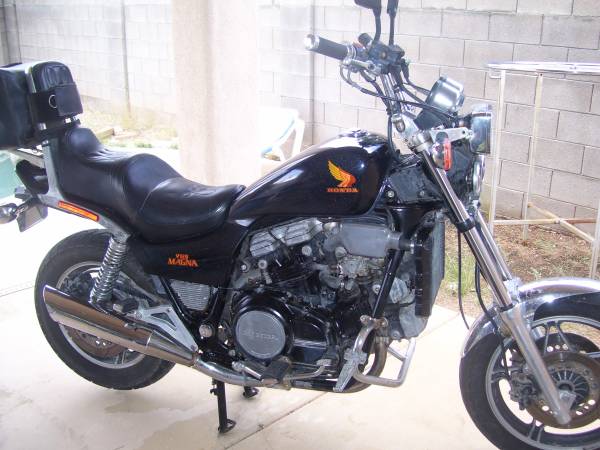
In the annals of motorcycle history, few machines evoke the same blend of raw power and pioneering spirit as the 1983 Honda V65 Magna. A bike that dares to disrupt conventional norms, the V65 Magna was more than just a machine; it was an audacious statement, a herald of muscle bike culture before the term gained widespread acclaim. This formidable two-wheeled titan invites an exploration into a world where engineering bravado met aesthetic boldness, challenging the riders’ notions of what a motorcycle could be in the early 1980s.
The genesis of the V65 Magna lies in Honda’s desire to push the boundaries of performance while maintaining a sophisticated balance between power and precision. At a time when motorcycles were often categorized as either cruisers or sportbikes, the Magna emerged as a hybrid—an uncompromising beast that combined the burly, torque-heavy attributes of a cruiser with the aggressive spirit of a sportbike. This confluence established the Magna as a bellwether for the muscle bike genre, a precursor to the heavily modified and performance-tuned motorcycles that would burgeon decades later.
Underneath its polished exterior, the V65 Magna housed a ferocious 1170cc V4 engine that was, for some, almost an engineering marvel. Each of its four cylinders contributed to a distinctive power delivery, characterized by incisive throttle response and a willing, throaty growl that could easily dominate city streets or stretch into the open highways. The engine’s capacity for producing 116 horsepower was staggering for its time, making the bike a legitimate contender in the race for domination among high-performance motorcycles. This powerplant was not merely about raw numbers; it symbolized a meticulous marriage of reliability and explosive performance seldom seen in this segment during the early 80s.
More than just an engine marvel, the V65 Magna’s chassis and suspension were meticulously crafted to harness its might without succumbing to unwieldy handling. The frame, a sturdy yet nimble steel double-cradle design, anchored the machine confidently on the road, offering astonishing stability at speed and a degree of agility that defied its seemingly cumbersome musclebike dimensions. Complementing this was an elaborate suspension setup—a combination of telescopic forks at the front and dual shock absorbers at the rear—that balanced comfort with stiffness, ensuring that the rider experienced an optimal blend of responsiveness and road-hugging confidence.
The Magna’s styling was yet another chapter in its storied narrative. Bold, aggressive, and unapologetically masculine, its muscular contours set it apart from the more streamlined or delicate designs of contemporaries. The bike’s broad, sculpted fuel tank and pronounced air intakes whispered of unleashed power, while its chrome details injected a glossiness that emphasized its premium stature. Yet, it avoided excess; instead, its design language spoke volumes through strength and purpose rather than flamboyance, a reflection of Honda’s intent to create a bike that resonated with a more discerning audience.
Ergonomically, the 1983 Honda V65 Magna struck a compelling balance—poised between comfort and control. Its wide handlebars offered commanding leverage, inviting riders to confidently tame the torque beast beneath them. The slightly forward-positioned foot controls provided a cruiser’s relaxed stance without sacrificing the ability to respond swiftly to the road’s demands. This hybrid ergonomics configuration not only facilitated longer rides with minimal fatigue but also maintained the V65’s aggressive riding posture, proving its versatility across multiple riding styles.
Innovation permeated every facet of the Magna, from mechanical to symbolic. It signaled a new era where raw horsepower was accessible without descending into the realm of unwieldy machines prone to mechanical fragility. The bike’s impressive braking system, featuring dual front discs, was a testament to safety evolving in tandem with performance enhancements. The brakes provided ample stopping power, a critical consideration for a machine capable of hurtling past 130 miles per hour—a speed figure that in 1983 bordered on the extraordinary for mass-produced motorcycles.
What makes the 1983 Honda V65 Magna so enthralling is not solely its mechanical specifications or its sculpted aesthetics, but its role as a cultural fulcrum. It represented a shift in how motorcycle enthusiasts perceived power and style. At a juncture where muscle cars were waning and cruisers dominated the rails, the Magna introduced a new narrative—one where power could be celebrated with sophistication rather than mere brute force. This redefinition opened pathways for future motorcycle designs that sought to amalgamate speed, comfort, and flair without compromising reliability.
Moreover, the V65 Magna fostered a devoted following that appreciated its distinct synthesis of sport and muscle bike attributes. Riders were drawn to its unpretentious yet muscular personality, one that suggested mastery over the road while embracing the aesthetics of personal expression. This cult status endured beyond its production years, influencing custom builders and motorcycle aficionados who continue to celebrate and restore these machines as embodiments of a pivotal moment in motorcycle evolution.
Even today, the 1983 Honda V65 Magna endures as a testament to a forward-thinking philosophy—an engineer’s audacious vision made manifest in steel, rubber, and flame. It challenges the modern rider’s assumptions about the boundaries of design and performance in the early 1980s. The Magna’s legacy is not just in its impressive specs or its aggressive styling; it lies in its ability to inspire a reevaluation of what muscle in motorcycling truly means. It is a muscle bike before its time, a bridge between eras, and a reminder that innovation is often about daring to deviate from the well-trodden path.
In the grand tapestry of motorcycle lore, the 1983 Honda V65 Magna stands tall, its engine’s roar echoing a promise that power and grace are not mutually exclusive. It invites enthusiasts and historians alike to revisit a machine where form met function in harmonious defiance of convention—a motorcycle that still captivates with its unyielding spirit and unmatched charisma.