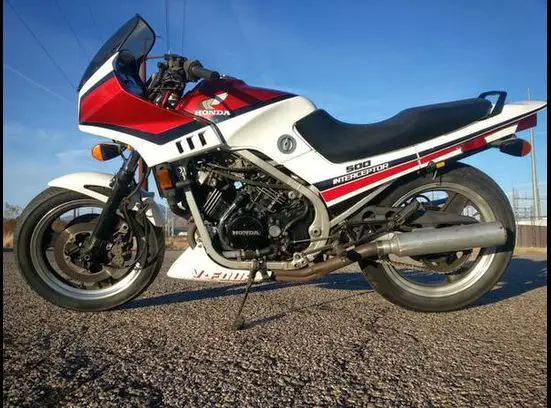
Have you ever wondered what it takes for a motorcycle to etch its name indelibly into the annals of track legend? The 1984 Honda Interceptor lineup—the VF500 and VF750—offers a fascinating case study, blending groundbreaking engineering with a dash of racing prowess. These bikes didn’t just compete; they challenged the very norms of sportbike culture during a vibrant era of motorcycling innovation. But what made these machines so iconic? And why does their legacy endure among enthusiasts and historians alike?
To comprehend the impact of the 1984 Honda Interceptor models, it’s essential to appreciate the backdrop against which they emerged. The early 1980s was a transformative time in motorcycle technology. Manufacturers scrambled to build lighter, faster, and more agile machines, leveraging the burgeoning advancements in metallurgy, aerodynamics, and powertrain design. Honda, a titan in the industry, was no exception. Their answer came in the form of the VF series, featuring the Interceptor badge, which cleverly combined performance and style in a way few contemporaries could match.
The 1984 Honda VF500 Interceptor was a middleweight marvel. With a compact, liquid-cooled, 16-valve V4 engine, it embodied the spirit of racing technology accessible to the everyday rider. Displacing 498cc, it delivered a harmonious blend of power and manageability. This bike was designed to excel at the track but retained enough civility for street use. The VF500’s crisp throttle response and sophisticated chassis architecture invited riders to push boundaries, making it an impeccable training ground for aspiring racers and an exhilarating companion for enthusiasts seeking spirited rides.
On the other end of the spectrum stood the Honda VF750 Interceptor. This larger sibling boasted a 748cc V4 engine that punched well above its weight class. Harnessing the same liquid-cooled, DOHC, 16-valve configuration as the VF500 but with amplified displacement, the VF750 was a veritable powerhouse. It offered thrilling torque delivery and superior top-end speed, attributes that secured its status as a formidable contender on national circuits and street races alike. Its aerodynamic fairings and muscular yet refined frame gave riders not only confidence but an unmistakable sense of dominance on any course.
What fundamentally distinguished the Interceptor series from its rivals was Honda’s innovative use of V4 powerplants during a time dominated primarily by in-line four-cylinder engines. This configuration granted the Interceptors a unique engine character: smoothness combined with an aggressive powerband. The V4 layout reduced engine vibration and enhanced throttle precision, characteristics that became crucial for maintaining control at high speeds. Coupled with Honda’s meticulous engineering, this translated into a riding experience that felt both visceral and composed.
Yet, the road to legendary status was not without challenges. The complexity of the V4 engines, while an engineering feat, introduced maintenance intricacies that some riders found daunting. The timing belts, valve adjustments, and the carburation setup demanded a level of mechanical acumen unusual at the time. Could this be the trade-off for superior performance? For many aficionados, the answer was a resounding yes.
Moreover, the 1984 Interceptor models were also remarkable for their chassis design. Honda implemented aluminum perimeter frames that reduced weight and increased rigidity, enhancing handling characteristics dramatically. The suspension systems, featuring adjustable components unprecedented in some middleweight classes, granted riders the ability to fine-tune their bikes to track conditions or personal preferences. The braking systems, though not as advanced by modern standards, utilized dual front discs that imbued the machine with respectable stopping power, instilling confidence during aggressive maneuvers.
The aesthetic allure of the 1984 Interceptors also played a non-negligible role in cementing their reputation. Sporting sharp, angular bodywork and aggressive graphics, these motorcycles reflected the era’s zeitgeist—a fusion of futurism and mechanical precision. The compact headlight assemblies, sculpted tanks, and aerodynamic fairings didn’t just serve a functional purpose but also created visual statements that resonated with riders who craved something that looked as fast as it felt.
Racing pedigree further amplified the Interceptor’s legend. Both the VF500 and VF750 found favor in competitive settings ranging from club races to professional national championships. Their nimbleness and punchy power delivered decisive advantages on tight circuits, where handling and acceleration trump raw horsepower. Notably, the VF750 Interceptor’s success in endurance races underscored its reliability, a feature not always guaranteed in high-performance motorcycles of the era.
However, an intriguing paradox emerges when considering the evolution of sportbikes after the Interceptors’ debut. Although Honda’s V4 design was lauded for its virtues, it gradually yielded to the rise of multi-cylinder inline fours favored for their straight-forward tuning and manufacturing costs. This begs the question: Did the Interceptor series define an era of engineering brilliance destined to be outrun by economic pragmatism, or is there an enduring appeal to the distinctive V4 engine layout that modern motorcycles still tap into?
Fast forward to today, and the 1984 Honda Interceptor 500 and 750 still evoke admiration and nostalgia. Their blend of technology, performance, and style serves as a benchmark for contemporary sportbikes. For collectors, the Interceptors represent a quintessential piece of motorcycling heritage, encapsulating a time when manufacturers dared to think differently and ride boldly. Riders and historians continually dissect these machines, celebrating not only their accomplishments on the tarmac but the audacity behind their inception.
Ultimately, what makes the 1984 Honda Interceptor 500 and 750 so compelling is their synthesis of innovation and performance wrapped in a package that challenged conventions. They dared riders to elevate their skills, to embrace the complexity of a finely tuned machine, and to engage in the pure thrill of speed and control. While modern technology might have eclipsed some mechanical aspects, the spirit of the Interceptor endures, inviting riders old and new to ponder: In the relentless pursuit of track excellence, what truly defines a legend?