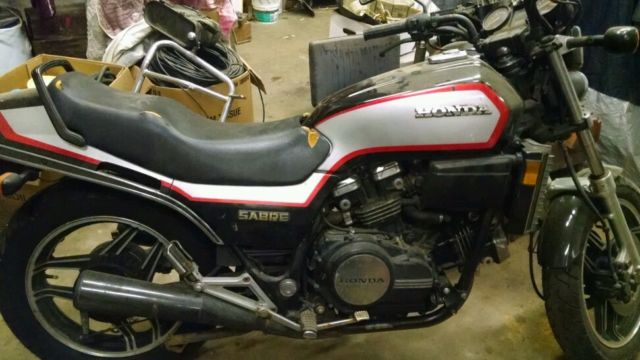
In the pantheon of 1980s motorcycles, the 1984 Honda Sabre 700 and its close sibling, the V65, stand as compelling embodiments of a delicate dichotomy—speed versus comfort. Much like a masterful symphony that balances the crescendo of powerful brass against the delicate hum of strings, these motorcycles masterfully intertwine raw velocity with rider-centric elegance. They beckon enthusiasts not just with their mechanical prowess, but with a unique allure that transcends mere transportation, morphing each ride into an intimate dance between man and machine.
The 1984 Honda Sabre 700, often overshadowed by the famed V65, possesses its own distinct character, marked by a more measured approach to performance without sacrificing the thrill. It can be likened to a finely tuned sports sedan—engineered to deliver vigor and agility, yet wrapped in a layer of poised sophistication designed to embrace the rider’s body and spirit. The V65, by contrast, is a tempest on wheels, a steel beast roaring with unrelenting power, a quintessential embodiment of Honda’s quest to dominate the superbike segment of its era.
At the heart of these motorcycles lies the V4 engine—a mechanical marvel delivering a symphony of combustion and motion. In the Sabre 700, this engine is meticulously calmed to produce a smooth but potent power curve. The displacement stands at approximately 698cc, paired with Honda’s sophisticated carburetion and liquid cooling system, ensuring that the rider experiences neither undue jerkiness nor overheating—a common woe in high-performance motorcycles of the decade. This architectural design allows the Sabre to be simultaneously reactive and contemplative, capable of acceleration while nurturing a serene riding posture.
The V65, on the other hand, escalates these elements to zenithal proportions. Its 653cc V4 engine, with higher state of tune, unleashes a ferocious 110 horsepower, an impressive figure that placed it among the elite superbikes of its time. The V65 was Honda’s answer to the burgeoning demand for motorcycles capable of canyon carving and track domination, yet tethered to a famed Japanese reliability rarely witnessed in similarly potent contemporaries. The resultant experience was not just speed; it was an adrenaline-fueled assertion of domination, a machine designed to spike heart rates and eclipse horizons.
However, raw speed only paints half the portrait. The Sabre 700 emerges as the connoisseur’s choice—a motorcycle that prioritizes ergonomic harmony and rideability. The chassis, constructed of steel double cradle frames, balances rigidity with pliability, mitigating road harshness without compromising control. Its suspension system, tailored towards comfort with conventional telescopic forks up front and twin shocks at the rear, invites the rider to linger on long stretches without fatigue. The seating ergonomics, featuring a slightly upright posture and ample cushioning, whisper promises of prolonged journeys unmarred by discomfort. Here, the Sabre transforms the concept of a muscle bike into something more civilized and approachable.
In juxtaposition, the V65’s architecture leans heavily into sport riding physiology—with a marginally more aggressive posture that channels power more directly but demands commitment from the rider. Its suspension is stiffer, the frame designed for twitchy responsiveness and razor-sharp cornering rather than comfortable cruising. The twin-disc brakes at the front ensure that the kinetic energy harnessed by this power machine is under precise control, allowing for late braking in spirited drives. The result is a ride that is almost symphonic in its intensity: thrilling, breath-stealing, and demanding respect.
The unique appeal of the Sabre 700 versus the V65 is perhaps best encapsulated in their contrasting philosophies towards motorcycle design. The Sabre is the eloquent poem—measured, expressive, and with an undercurrent of restrained vigor. Its beauty lies in subtleties: the matte finishes, the balanced instrumentation, the gentle growl of its exhaust notes that hint rather than shout. The V65 is an impassioned orator—bold, loud, unmissable. Its presence commands an audience, its aggressive soundscape and muscular physique are manifestations of unyielding ambition and rebellion.
Both motorcycles share lineage and many mechanical cousins, yet their appeal to enthusiasts speaks to very different experiences. The Sabre caters to the rider who cherishes the journey itself, the sensation of the open road whispering stories beneath polished chrome. It is a companion for those who find joy in seamless cruising, where the balance between power and comfort is a deliberate dance step. The V65 appeals to the adrenaline seeker, the tactician who measures time in acceleration and deceleration, who finds poetry not in the path but in the rush through the twisties.
In contemporary retrospectives, these motorcycles invite a romanticism that transcends technical specifications. They evoke the era’s shifting motorcycle culture, where manufacturers explored the twin peaks of performance and practicality, sometimes within the same model family. The Sabre 700 invites nostalgia for refined balance, whereas the V65 ignites the pulse with undiluted fervor.
The 1984 Honda Sabre 700 and V65 are not merely tools of transport; they are canvases painted with intention and passion. Together, they embody an age when the boundaries between speed and comfort were artfully navigated, revealing the nuanced spectrum of motorcycling desires. To ride the Sabre is to savor a whispered promise of adventure; to mount the V65 is to embrace the roar of unrestrained potential.
Ultimately, the debate between speed and comfort—between the Sabre 700 and the V65—underscores a timeless truth: the best motorcycle is one that resonates deeply with the rider’s soul. Whether courting the open highway with gentle grace or conquering the curves with aggressive zeal, these iconic Hondas remain enduring symbols of a bygone era when speed flirted harmoniously with comfort, forever etched in the annals of motorcycling history.