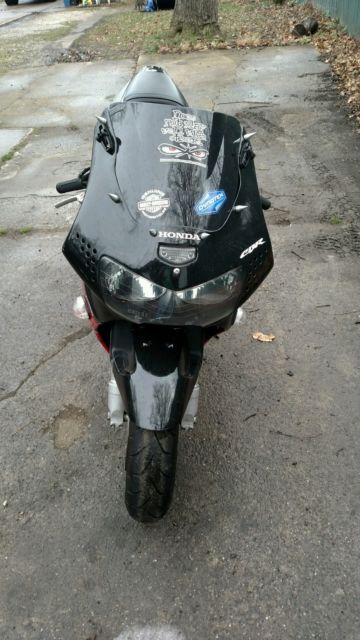
The 1998 Honda CBR900RR stands as a paragon of sportbike engineering—a motorcycle that, despite the relentless march of technology, maintains a cult-like reverence among enthusiasts and street riders alike. It’s not merely a relic from a bygone era; it remains a bona fide street weapon capable of carving apexes and dominating backroads with a blend of agility, power, and character that many modern machines struggle to emulate. This enduring fascination begs the question: what precisely keeps the 1998 Honda CBR900RR relevant and revered some two decades after its release?
Firstly, the CBR900RR, also known as the Fireblade in many markets, heralded a paradigm shift when it hit the scene in the early 90s. By 1998, Honda had refined this legendary machine to near perfection, crafting a bike that was simultaneously lighter, more powerful, and more nimble than many of its competitors. The emphasis on creating a motorcycle that was as balanced in form as it was function gave it an edge. Unlike other supersport machines that pursued brute horsepower, the CBR900RR favored an equilibrium between mass centralization, chassis rigidity, and engine versatility. Consequently, it is a bike that rewards precision riding and offers a tactile connection that transcends mere transportation.
The 1998 iteration specifically introduced enhancements that underscored Honda’s commitment to continual improvement. The suspension was tweaked for sharper handling—showcasing fully adjustable Showa forks and a redesigned swingarm that interacted harmoniously with a revised frame geometry. This finesse in suspension tuning renders the motorcycle capable of maintaining composure and confidence even at aggressive lean angles, an attribute still prized by riders who seek a resilient yet playful companion for street and canyon runs. The CBR900RR embodies the elusive goldilocks zone of sportbikes: not too heavy to bog down in the twisties, yet not so light as to lack stability and substance.
Beyond its mechanical prowess, the 1998 Honda CBR900RR offers an aesthetic appeal that is simultaneously timeless and aggressive. Its sculpted fairings, aerodynamic lines, and compact dimensions create an evocative silhouette that commands attention without the need for overly aggressive flourishes. This design ethos emphasizes function over flamboyance but never at the expense of visual drama. The bike’s profile exudes an understated menace, a promise of speed and agility beneath its streamlined guise. This visual balance perfects its street weapon persona—ready to intimidate yet refined enough to garner admiration from purists.
One frequently overlooked aspect of the 1998 CBR900RR’s magnetism lies in its engine character. The inline-four powerplant—displacing approximately 900cc—delivers a robust and linear powerband. While not the outright most powerful machine in the category, its engine offers a blend of torque and rev-happiness that suits spirited street riding and occasional track excursions equally well. Its responsiveness is immediate, providing tangible feedback that melds rider intent with mechanical action. This synergy between rider and machine fosters a type of kinesthetic dialogue that modern motorcycles, with their electronic aids and sometimes sterile feel, often lack.
Furthermore, the absence of an invasive electronic rider aid package in the 1998 model adds to its pure riding engagement. The CBR900RR challenges the rider to master throttle control and chassis dynamics organically, without relying on traction control or cornering ABS. This element of purity appeals to a demographic of riders who crave unfiltered control and regard electronic intervention as a barrier between man and machine. The tactile and visceral experience it proffers remains unmatched in an era increasingly dominated by electronic sophistication.
Beyond the tangible merits, there is a deeper cultural resonance embedded within the 1998 Honda CBR900RR. It represents an epoch when motorcycles were celebrated for mechanical ingenuity and rider skill rather than digital wizardry. This period evokes nostalgia for many, serving as a canvas upon which personal memories and community narratives are painted. Owning or simply riding a ‘98 Fireblade becomes an act of connection—not only to the machine but to a lineage of riders who sought purity, performance, and passion enveloped in steel and rubber. The motorcycle transcends its role as a mere vehicle to become a symbol of authenticity and unadulterated adrenaline.
Mechanically reliable and supported by a vast aftermarket ecosystem, the 1998 CBR900RR also sits comfortably within practical consideration. Its parts remain accessible and reasonably priced, its maintenance and tuning approachable for hobbyists and professionals alike. This accessibility furthers its allure, keeping it in circulation on the streets rather than relegated to museum shelves or private collections. Riders who choose the CBR900RR know they’re harnessing a machine that balances vintage charm with functional practicality.
In terms of performance longevity, the 1998 Honda CBR900RR continues to challenge modern counterparts in real-world settings. While newer motorcycles boast superior numbers on paper—accelerations measured in milliseconds, electronic stability management, and lightweight carbon components—the Fireblade’s riding experience cannot be distilled purely into metrics. It excels where quantifiable data ends: in the realm of rider confidence, the raw thrill of managing a throttle with delicate finesse, and the intimate connection with the road. It’s a motorcycle that demands respect and rewards mastery.
It is, however, crucial to acknowledge the limitations that come with age. In a rapidly evolving landscape of motorcycle technology, the 1998 model cannot compete on technological frontiers such as ride-by-wire throttle systems, selectable engine maps, or advanced aerodynamic package. Nor does it cater to the casual rider who prioritizes comfort, convenience, and electronic intervention over mechanical purity. Yet, for connoisseurs of motorcycling culture, its anachronistic qualities only enhance its charisma.
Ultimately, the enduring reverence for the 1998 Honda CBR900RR reveals something profound about the symbiotic relationship between rider and machine. It reaffirms a collective desire for machines that speak to us not only through performance stats but through the experience—through the sensation of raw, mechanical feedback unmarred by overbearing technology. It invites riders to rediscover the essence of street riding, where skill, rhythm, and intuition intersect on asphalts and curving roads. The 1998 Fireblade is not merely an artifact of the past; it is a vivid and vital testament to what it means to wield a street weapon with heart and soul.
In conclusion, while the 1998 Honda CBR900RR may not be the flashiest or most technologically advanced motorcycle in modern times, it remains an almost mythic figure among sportbikes, a relic that continues to inspire awe and respect. It embodies an era where engineering discipline, rider engagement, and aesthetic restraint converged to produce a machine whose allure defies obsolescence. For those who appreciate motorcycles as interactive artforms rather than mere transportation devices, the 1998 Fireblade still burns bright—an enduring street weapon, fierce and faithful, ready to break the horizon time and again.