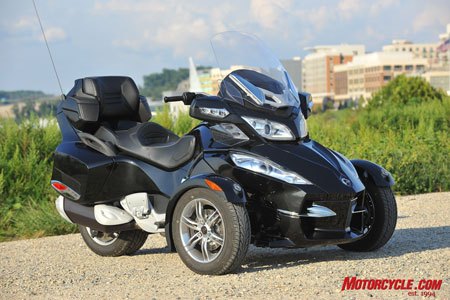
The 2010 Can-Am Spyder RT occupies a provocative space within the world of motorized vehicles, challenging traditional categories and provoking a reevaluation of what exactly constitutes a motorcycle. At first glance, the Spyder’s three-wheeled configuration, broad stance, and unique design elements seem to place it outside the established realm of two-wheeled motorcycles. Yet, its name, marketing, and enthusiast following suggest that it belongs firmly within the motorcycling tribe. This duality has piqued curiosity and ignited conversations about identity, functionality, and the evolving nature of personal transport machines.
The immediate observation that sparks debate is the vehicle’s tricycle architecture. Unlike the archetypal motorcycle that balances on two wheels and requires physical leaning and countersteering for directional control, the Spyder RT features two wheels upfront and one at the rear. This layout imparts distinct riding dynamics—greater inherent stability, a different center of gravity, and a divergence from the lean-and-bank method typically synonymous with motorcycles. For some purists, this deviation disqualifies the Spyder from the motorcycle category, branding it as something else entirely—part car, part bike, and fully unique.
However, reducing the Spyder to a mere curiosity or a “sidecar without a bike” diminishes its innovation and purpose. The Can-Am Spyder RT was engineered with intent: to blend the exhilaration of motorcycling with enhanced stability and comfort for longer touring adventures. The “RT” suffix itself signifies this touring pedigree—denoting luxury, weather protection, and amenities that other motorcycles often lack or offer only as optional add-ons. The design embraces dual saddles, expansive storage compartments, and sophisticated electronics, ensuring that journeys are not just about speed or adrenaline, but also about comfort and practicality.
One cannot discuss the fascination with the Spyder RT without addressing the psychological and emotional elements that underpin rider attraction. Traditional motorcycles demand a visceral engagement—a symbiotic relationship where the rider’s body becomes an integral part of the machine’s control system. Leaning into corners, balancing at low speeds, and the near-sensory feedback through handlebars and seat create a primal connection. The Spyder, by virtue of its stability and different control mechanisms, abstracts some of this raw connection yet introduces an alternative allure: a sense of safety without sacrificing the open-air freedom of motorcycling.
The Spyder’s appeal extends to demographics traditionally sidelined by conventional motorcycles. For riders with balance issues, reduced physical strength, or apprehensions about roadside stability, the Spyder offers a viable entry point into motorcycling culture. It invites a broader audience without compromising the exploratory ethos of two-wheeled riding. This inclusivity speaks to an evolving definition of motorcycle enthusiasts—not bound strictly by physical capability, but by a shared passion for experiential travel and mechanical engagement.
Furthermore, the 2010 model embodies technological advancements that straddle the worlds of motorcycles and automobiles. Electronic stability control, anti-lock brakes, and power steering elevate the vehicle’s capability, providing riders with confidence-inspiring tools. These systems, while commonplace in cars, were groundbreaking when integrated into a motorcycle platform, even a three-wheeled one. The Spyder RT’s dashboard incorporates digital interfaces, Bluetooth connectivity, and integrated GPS navigation—features designed to enhance the touring experience rather than merely serve as gimmicks.
In considering why the Spyder captivates attention, one must also reflect on its aesthetic language. It eschews the minimalist, aggressive lines of sportbikes and the rugged technicality of cruisers, opting instead for a futuristic, almost spaceship-like presence. The proportions of its sprawling front wheels, the swept-back windscreen, and sculpted body panels create a visual statement that is both attention-grabbing and enigmatic. This design philosophy invites observers to question their preconceived notions of motorcycle form and function, fostering intrigue and discussion.
The very ambiguity surrounding the Spyder’s classification mirrors a broader cultural moment wherein mobility, identity, and technology intertwine. As urban landscapes grow denser and transportation preferences shift, vehicles like the Can-Am Spyder RT embody hybrid solutions that defy traditional boundaries. They suggest that the future of motorcycling—and personal mobility at large—might not reside solely in adhering to past templates but in embracing novel configurations that offer new experiences without discarding the essence of adventure.
In the end, the question “Motorcycle or something else?” may be less about rigid definitions and more about the relationship between rider and machine. The 2010 Can-Am Spyder RT encourages a reassessment of both. It challenges enthusiasts and newcomers alike to broaden their horizons, to appreciate stability as well as agility, luxury as well as rawness, and innovation as well as tradition. It is an artifact of evolution, signaling that the motorcycle’s spirit is less about the number of wheels or styling conventions and more about the freedom and exploration it enables.
Ultimately, the Spyder RT’s enduring fascination lies in its dual nature—part motorcycle, part reimagining of personal transport. By straddling these worlds, it transcends categorization and invites ongoing dialogue about what it means to ride, to explore, and to connect with machines that amplify human experience. Whether deemed a motorcycle or otherwise, the 2010 Can-Am Spyder RT undeniably enriches the landscape of motorcycling, expanding the possibilities for where, how, and why we ride.