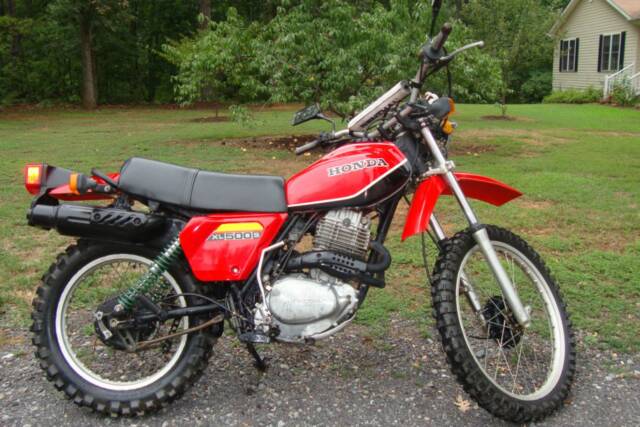
The 1979 Honda XL500 stands as a compelling testament to an era when motorcycles were sculpted not just for speed, but for versatility and rugged dependability. This vintage dual-sport motorcycle has long been admired by enthusiasts and casual riders alike for its unpretentious yet formidable character. While many marvel at its enduring charm and purposeful design, there lies a deeper fascination beneath its galvanized exterior — a fusion of engineering pragmatism and the evocative freedom of exploration that still resonates today.
Built during a period when the motorcycle industry was embracing the burgeoning dual-sport segment, the XL500 was Honda’s firm statement of intent. Its genesis was rooted in a desire to create a machine that could gracefully balance the rigors of off-road terrain with the demands of on-road commuting. The XL500’s architecture manifests this ethos with unmistakable clarity. It features a robust 497cc air-cooled, single-cylinder four-stroke engine, a powerplant that offers a commendable blend of torque and reliability. The simplicity of this engine design contributes greatly to the bike’s longevity, a quality seldom rivaled in machines of any vintage.
This motorcycle’s frame and suspension system are equally pragmatic, designed to withstand the unpredictable challenges encountered beyond paved roads. A dual-sport bike, by definition, traverses diverse conditions — gravel, mud, rocky trails, and highway tarmac — and the XL500 addresses each with mechanical finesse. Its long-travel suspension, coupled with high ground clearance, endows it with a nimbleness usually absent in heavier adventure bikes. The result is a motorcycle that feels dynamic whether winding through tight forest paths or cruising open country roads.
One of the remarkable aspects that engenders such deep-seated admiration among collectors and riders is how the 1979 XL500 encapsulates a purity rarely witnessed in modern dual-sport designs. This is a machine uncluttered by superfluous electronics or a barrage of controls. Instead, it offers a pure riding experience, unfiltered and immediate. Riders are intimately connected with the mechanical essence of their motorcycle, attuned to the thrum of its engine and the subtle feedback from the terrain beneath its knobby tires. It is an experience as tactile as it is exhilarating.
The aesthetics of the XL500 contribute notably to its timeless appeal. It possesses an austere yet aggressive silhouette, featuring classic angular lines and a high-mounted exhaust pipe that hints at its off-road capabilities. Its fuel tank, often finished in bold or earthy hues, combines form with function — the shape carries enough volume for extended journeys while maintaining a slim profile to facilitate rider maneuverability. The ergonomics are deliberately set for versatility, striking a balance between comfort and control, whether seated or standing atop the footpegs during more demanding trail sections.
In examining why the 1979 Honda XL500 still captivates riders more than four decades after its release, one must consider its cultural footprint as well. During the late 1970s, dirt biking and trail riding were gaining substantial popularity, signaling a shift in consumer interests towards motorcycles that could serve multiple purposes. The XL500 emerged as a pivotal model that bridged the gap between utilitarian off-roaders and street-legal motorcycles. Its adoption and adaptation worldwide imbue it with a storied legacy, shaped by countless adventures, modifications, and restorations.
The motorcycle’s cult status is, in many ways, intertwined with the nostalgia it invokes. It calls to mind an epoch when motorsport was defined more by exploration and less by specialization. Restorers and hobbyists cherish the XL500 not only for its mechanical soundness but for the opportunity it presents to revive a piece of motorcycling heritage that harmonizes ruggedness with simplicity. It stands as a canvas for customization, whether through performance tuning or aesthetic enhancements, allowing each owner to imprint their narrative upon a machine that is fundamentally adaptable.
Technically, the XL500’s four-stroke engine offers a pronounced responsiveness uncommon for its time, especially when juxtaposed with the prevalent two-stroke counterparts. This characteristic granted it a smoother power delivery, reduced emissions, and heightened fuel efficiency — elements that contributed to its practicality and enduring relevance. Coupled with a five-speed transmission, it facilitated a versatile spread of ratios suitable for both low-speed technical trail riding and higher speed highway travel.
Maintenance and mechanical simplicity have further cemented the XL500’s status as a favorite among DIY mechanics and riders seeking reliability without complexity. The air-cooled engine readily dissipates heat, mitigating overheating risks common to liquid-cooled systems. Carburetor tuning, valve adjustments, and other routine servicing remain straightforward, promoting a sense of empowerment among owners. This accessibility ensures that the bike remains operational and relevant in a modern context, eschewing obsolescence for longevity.
Moreover, the tactile interaction with the XL500 — from the feedback of its clutch lever to the linearity of its throttle response — fosters a connection often lost in today’s heavily electronic motorcycles. Riders find themselves recalling why motorcycling originally captivated their imagination: the intimate dance between human and machine across varied terrain. This experiential depth is a large part of why the 1979 Honda XL500 maintains a lasting allure, transcending generations and trends.
In a world where motorcycles increasingly incorporate cutting-edge technology and intricate electronics, the XL500 reminds us that mechanical elegance can arise from simplicity paired with purposeful design. It embodies the enduring appeal of dual-sport motorcycles but does so by distilling what is essential to their identity. Every bolt, every tube on this bike speaks to resilience, practical engineering, and the spirit of adventure.
The 1979 Honda XL500 is more than a vintage motorcycle; it is a living artifact that continuously delivers, not solely in performance but in the stories and experiences it facilitates. Its legacy lies in the harmony of form and function, tradition and innovation, reliability and thrill. For those who appreciate the nuances of motorcycling history and quality, the XL500 endures not just as a relic but as a vibrant, spirited ride that remains relevant — a true testament to the timeless joy of two wheels.