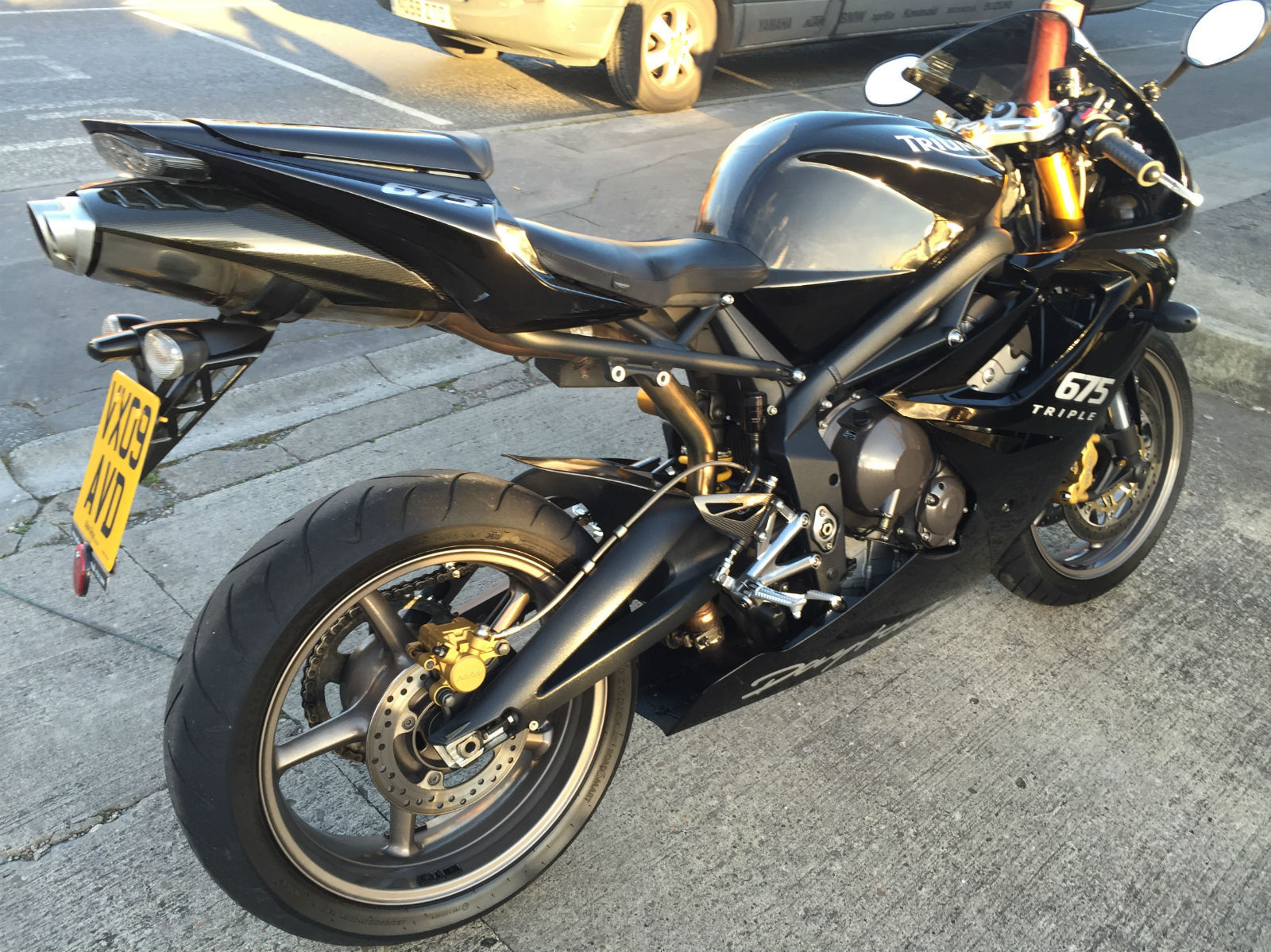
In the realm of middleweight superbikes, the 2009 Triumph Daytona 675 arrives not just as another contender but as a bold statement—a track weapon meticulously engineered to rewrite expectations and redefine the sportbike category. It is a machine that demands attention, promising enthusiasts a transformative experience that challenges preconceived notions of performance, handling, and rider engagement. Far beyond mere specs and numbers, the Daytona 675 embodies a philosophy that dares to shift perspectives and stoke curiosity about what a 675cc motorcycle can truly achieve on both asphalt and adrenaline levels.
From the outset, the Daytona 675 strikes a rare balance between aggressive aesthetics and purposeful design. Triumph’s razor-sharp lines, punctuated by an assertive triple headlight array and sculpted fairings, hint at its racing pedigree while retaining an elegance seldom seen in its class. Its compact chassis and lightweight frame are not only visual triumphs but serve as the fundamental architecture enabling precision and agility on the track, where every millisecond counts and every corner demands unwavering confidence. The 2009 iteration of the Daytona 675 refuses to settle for mediocrity, instead carving out its niche with a synergy of cutting-edge engineering and raw passion.
At the core of the 2009 Daytona 675 lies an extraordinary 675cc inline-three engine, a configuration that has become synonymous with Triumph’s identity and competitive edge. This powerplant isn’t merely about displacement; it evokes a distinctive character, marrying the punchy torquey nature of twins with the high-revving exuberance of fours. Producing approximately 123 horsepower at 12,500 rpm, it offers a linear power delivery complemented by a broad torque curve peaking at around 67 Nm. This combination ensures exhilarating acceleration without the abruptness that often alienates less experienced riders, while satisfying purists craving precision throttle control. The sonic signature, a throaty yet refined growl emanating from the triple exhaust, adds to the sensory allure, captivating audibly as much as visually.
The chassis and suspension geometry of the Daytona 675 are arguably where the motorcycle’s true competitive spirit manifests. Constructed around an aluminum beam frame, it achieves an impeccably low center of gravity, contributing to nimble cornering capabilities and steadfast stability at high speeds. The front end employs a fully adjustable Showa 41mm USD fork, allowing riders to fine-tune compression and rebound damping, enhancing adaptability across various track conditions and personal preferences. At the rear, a Showa monoshock equipped with adjustable preload and rebound settings complements the front, providing balanced feedback and absorbing road irregularities with commendable composure.
Handling is further refined by the wheel and tire package. Lightweight 17-inch wheels wrapped in race-oriented rubber offer exceptional grip and rapid directional changes, instilling a sense of security even when tackling technical sections or aggressive lean angles. The Daytona 675’s geometry features a raked fork angle of approximately 24.5 degrees and a relatively short wheelbase near 54 inches, constructs that contribute to sharp steering response without sacrificing high-speed composure—a rare equilibrium that few middleweights achieve.
Braking performance on the 2009 Triumph Daytona 675 is robust and confidence-inspiring, critical attributes for a track-focused machine. Twin 308mm discs upfront gripped by four-piston calipers deliver powerful, progressive stopping force, essential for late braking into hairpins and rapid deceleration zones. The rear brake, while comparatively modest with a single 220mm disc, offers ample support and modulation. This braking ensemble not only reassures but allows the rider to wrestle the bike’s considerable power with finesse. Anti-lock braking systems are absent, a deliberate choice reflecting the model’s purist orientation, inviting skilled riders to finely balance lock-up thresholds and confidence levels.
The ergonomics of the Daytona 675 evoke the essence of a thoroughbred racer, designed to prioritize control and weight distribution over leisurely comfort. The seat height, set at roughly 32.3 inches, positions the rider in a forward-leaning stance that optimizes aerodynamic efficiency and chassis feedback. Clip-on handlebars and rear-set footpegs encourage an aggressive posture conducive to spirited riding. While this favors track days and spirited canyon carving, it may challenge those seeking a more relaxed commute. Yet, it is precisely this uncompromising setup that underscores its dedication to performance.
Electronics and instrumentation on the 2009 Daytona 675 are straightforward yet purposeful. A minimalist digital dash provides essential data—tachometer, speed, trip meters—without overwhelming the rider with extraneous information. This simplicity aligns with the bike’s ethos, placing focus on mechanical feedback rather than electronic intervention. The absence of traction control and riding modes, common in contemporary rivals, emphasizes rider skill and mechanical purity, further enhancing its appeal to aficionados who relish unfiltered connections between rider, machine, and track.
On track, the 2009 Daytona 675 reveals its true mettle. Its blend of power, balance, and feedback crafts an intoxicating riding experience that stretches beyond raw speed. Corner entry is marked by precise turn-in and a chassis that communicates subtle changes in traction and lean angle, encouraging exploration of the edge without trepidation. Acceleration out of corners is crisp and controlled, with the engine’s flexible torque allowing for rapid throttle modulation. High-speed stability is impressive, considering its compact dimensions, and the bike resists unsettling vibrations or twitchy behavior even when pushed to its limits.
But the appeal of the Daytona 675 transcends pure performance metrics. It invites riders to reconsider what a middleweight superbike can embody by merging British engineering heritage with contemporary racing technology. The emotional impact it imparts—through sound, feel, responsiveness—is a testament to the thoughtful craftsmanship woven into every component. It beckons riders to refine their technique, rewarding subtle inputs and cultivating a kinaesthetic connection that few motorcycles in its class can replicate.
In conclusion, the 2009 Triumph Daytona 675 stands as a compelling testament to focused design and uncompromising ambition. It promises a shift in perspective—a recalibration of expectations—from the casual enthusiast to the seasoned track warrior. Rather than merely emulating larger liter-class counterparts, it carves its own identity through a symphony of engineering precision, exhilarating performance, and rider-centric philosophy. Those in pursuit of a middleweight machine capable of intelligent aggression and raw charisma will find in the Daytona 675 more than transportation; they will discover a partner in the relentless pursuit of speed, skill, and the purest form of motorcycling exhilaration.