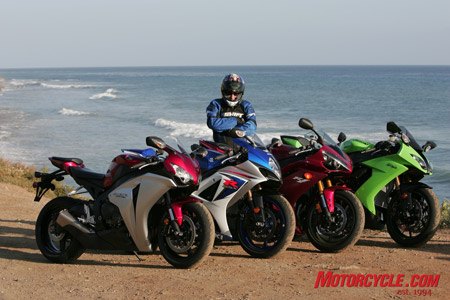
In the realm of high-performance motorcycles, the 2008 superbike segment emerged as a fierce battleground for supremacy, with Honda’s CBR1000RR, Suzuki’s GSX-R1000, and Kawasaki’s ZX10R marking the forefront of this mechanical war. These machines, each meticulously engineered and brimming with cutting-edge technology of their time, were not mere sportbikes; they embodied the relentless quest for perfection, challenging conventional wisdom and redefining the boundaries of speed, agility, and rider engagement.
At first glance, these superbikes present a tableau of razor-sharp aesthetics and aggressive stances, however, to the discerning enthusiast, each model symbolizes a distinct philosophy. The Honda CBR1000RR, historically lauded for its impeccable balance and accessible power delivery, continues to captivate riders seeking a machine that deftly marries track-ready prowess with street-legal temperament. Meanwhile, the Suzuki GSX-R1000 unleashes a more visceral experience, nestled within its chassis is a kinetic symphony of raw horsepower and nimble handling — a bike that demands respect and rewards precision.
On the opposite end of the spectrum stands the Kawasaki ZX10R, a celebratory triumph of big-displacement ferocity coupled with aggressive chassis dynamics. From the moment the rider twists the throttle, the ZX10R asserts itself with unrelenting vigor, embodying a race-bred spirit that can feel almost primordial in its intensity. Yet beneath this aggressive veneer lies a surprisingly sophisticated set of features designed to harness and optimize the formidable engine’s potential, offering not just brute strength but also a refined command over the machine.
The essence of this 2008 triad confrontation lies not just in outright horsepower figures, but in how these forces coalesce to define rider experience. The CBR1000RR’s inline-four engine, while seemingly restrained compared to its competitors, excels in delivering power with an almost surgical precision. Its chassis geometry and suspension tuning forge a harmony that reduces fatigue and allows for confident cornering and long hours in the saddle. Riders who value balance and an intuitive interface will find in the CBR a machine that responds gracefully to inputs, blending performance with predictability.
Conversely, the GSX-R1000 conveys its prowess through a more aggressive power curve and chassis setup, privileging quick transitions and razor-sharp agility. Suzuki’s technological innovations manifest in a lightweight frame and advanced engine management systems that prioritize maximum corner exit speed, a crucial advantage in closed circuits where every millisecond counts. The GSX-R1000 is not a bike for the faint-hearted; it challenges one’s skill and presence of mind, rewarding those who dare to push its limits with exhilarating acceleration and razor-edge handling.
Turning to the ZX10R, one must appreciate Kawasaki’s emphasis on outright power and cutting-edge electronic aids that were, at the time, groundbreaking. This superbike was one of the first in its class to integrate traction control systems and advanced ABS, equipping riders with unprecedented control despite the formidable output of the 998cc powerplant. The ZX10R’s chassis, inherently stiff and designed for aggressive riding styles, demands an assertive rider but, in return, delivers uncompromised feedback and responsiveness. It is the embodiment of a motorcycle that doesn’t just transport, but dominates its environment.
Investigating the technological arms race between these models uncovers a fascinating narrative of innovation pushing the envelope. The 2008 superbikes were not mere facelifts; they incorporated significant advancements in materials, electronics, and aerodynamics. Honda’s utilization of a compact, high-revving engine and a frame that prioritizes rigidity underscored precision. Suzuki’s incorporation of titanium valves and a race-tuned exhaust optimized power without sacrificing reliability. Kawasaki’s aggressive intake and fuel injection mapping maximized torque across a broad rev band, enabling lightning-fast throttle response.
What truly differentiates these machines, however, is how these mechanical blueprints translate to real-world riding scenarios. In urban environments, the CBR1000RR’s balanced demeanor offers an advantage, effortlessly weaving through traffic and delivering comfort on longer journeys. The GSX-R1000, meanwhile, feels more at home on twisty backroads and the race track, where its sharper handling can be fully exploited. The ZX10R thrives in high-speed situations, its raw potency and aerodynamic advantages offering a thrilling experience on open highways and circuits alike.
Beyond numbers and specifications, these motorcycles represent a paradigm shift in what riders expected from a liter-class sportbike in 2008. No longer was sheer horsepower sufficient; it was the subtle synthesis of control, electronic sophistication, ergonomics, and chassis dynamics that elevated each bike into a contender. The debates surrounding these machines echo a larger philosophical discourse—whether to prioritize finesse, ferocity, or adaptability as the ultimate expression of superbike performance.
Ultimately, the 2008 superbike battle among the CBR1000RR, GSX-R1000, and ZX10R invites enthusiasts and riders alike to reconsider their allegiances and expectations. It challenges preconceived notions of power and control, while simultaneously offering a spectrum of experiences tailored to varied riding styles and preferences. Each motorcycle, with its unique blend of technological prowess, engineering innovation, and sensory feedback, creates a distinct narrative in the history of sportbike evolution.
As the engines quiet and the dust settles on this remarkable era of motorcycle engineering, the lingering question remains: which of these machines truly defined the future of superbikes? Perhaps the more profound answer lies not in declaring an outright champion, but in appreciating the nuanced advancements and spirited competition that these motorcycles fostered. They transformed a simple contest of speed into a multidimensional exploration of what it means to ride — demanding passion, respect, and an unyielding pursuit of excellence.