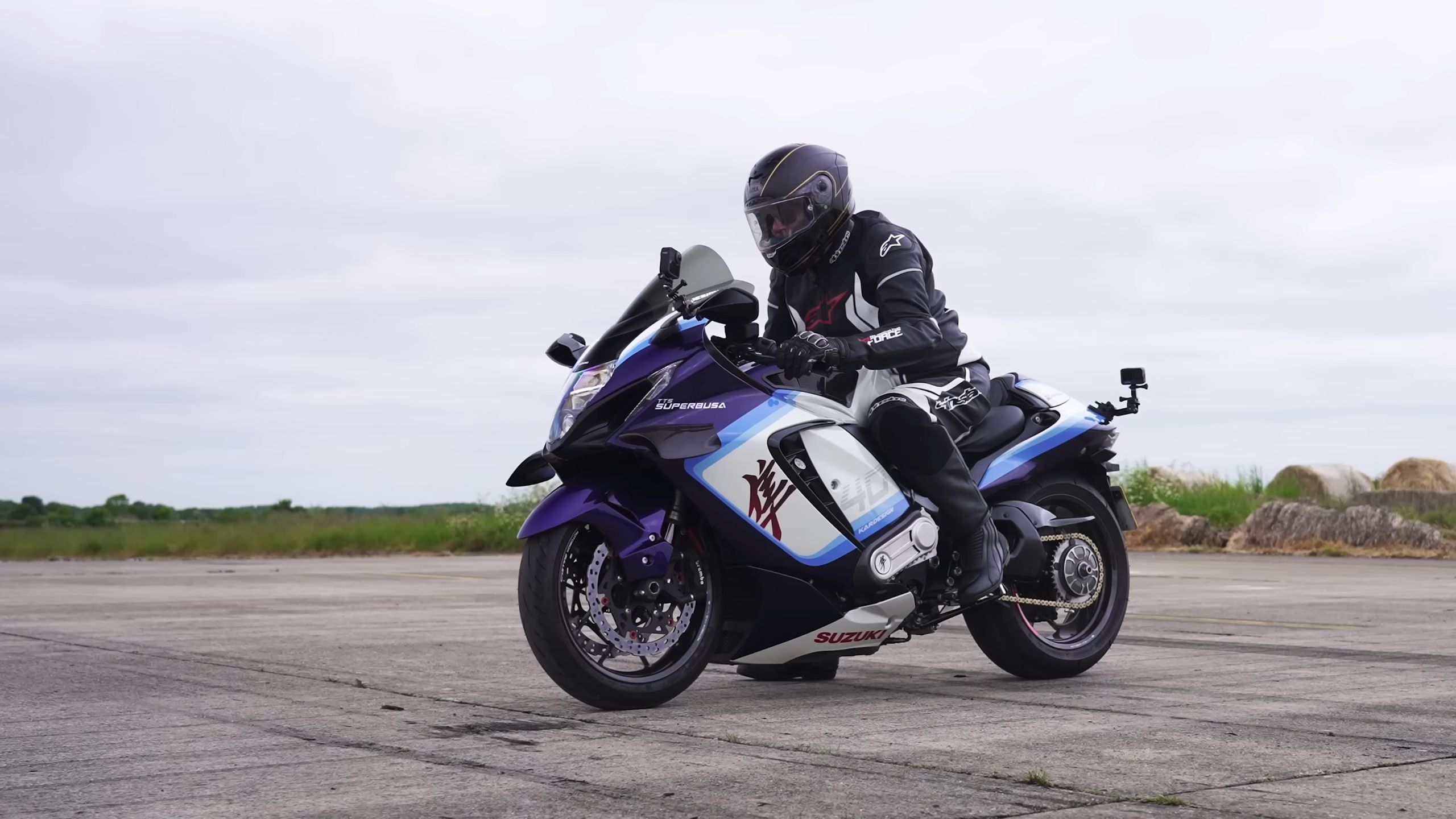
The 2008 Suzuki Hayabusa occupies a unique place in the pantheon of motorcycles, not merely as a relic of its era but as a relentless testament to speed and engineering prowess that continues to captivate enthusiasts worldwide. To truly appreciate why its top speed remains nothing short of extraordinary today demands a journey into the heart of its mechanical genius and the philosophy behind its creation.
The Hayabusa’s 2008 iteration built upon the foundation of a formidable legacy, one begun in 1999 with the release of the original model that shocked the motorcycle world by breaking the elusive 300 km/h barrier (approximately 186 mph). The 2008 version, while maintaining the iconic silhouette and aggressive stance, was a masterclass in refinement and performance calibration. At its core lies a 1,340cc inline-four engine, meticulously tuned to deliver blistering acceleration and an intoxicating top speed that remains competitive even against modern hyperbikes.
Often dubbed the “peregrine falcon” of motorcycles – a name that signifies predatory agility and unmatched velocity – the Hayabusa’s performance is not merely a function of raw power. Its aerodynamic design plays a symbiotic role. The 2008 model featured a streamlined frame engineered to slice through air resistance like a blade. Every curve and contour was conceived not just for aesthetics but to reduce drag and enhance stability at screaming velocities. This marriage of form and function enables the Hayabusa to punch through the air with minimal turbulence, an essential characteristic that elevates its top speed beyond mere numbers on a dial.
When discussing the “insanity” of the Hayabusa’s top speed, one must contextualize it against the backdrop of regulatory constraints and advancements in motorcycle technology over the ensuing decades. The 2008 Hayabusa could unleash a ferocious top speed of approximately 194 mph (312 km/h), a figure that remains jaw-dropping given contemporary speed restrictions imposed by manufacturers and governments alike. Many modern superbikes, despite technological leaps, have been electronically limited to comply with voluntary speed caps in the 186 mph realm, a sobering reminder of how the Hayabusa’s prowess may be artificially restrained in today’s market.
This natural limitation fosters a sense of reverence for the 2008 model. It represents a period when motorcycle manufacturers indulged in an unbridled arms race of velocity and power rather than immediate regulatory adherence. Consequently, the Hayabusa stands as a relic of an era unshackled by excessive speed governors, allowing adrenaline seekers to peer over the horizon of the conceivable.
Beyond straight-line performance, the Hayabusa’s engineering sophistication manifests in how it handles sheer roadholding and rideability at high speeds. Unlike many motorcycles that succumb to instability when pushed to the cusp, the Hayabusa’s chassis stability is nothing short of exemplary. This is a result of a finely harmonized suspension system and a rigid frame that mutually alleviate the pressures exerted by high-speed aerodynamics and road imperfections. For the rider, this translates into an unshakable confidence that the bike will respond predictably and safely, enabling fearless exploration of its upper velocity limits.
One cannot discuss the Hayabusa’s speed without acknowledging its impact on motorcycle culture and the psyche of riders. It’s a symbol of pushing boundaries—a daredevil’s dream, a technical enigma wrapped in bike leathers. The Hayabusa encourages a reevaluation of what is possible on two wheels, challenging conventional expectations and inspiring a deeper appreciation for the fusion of mechanical art and science. Its name alone evokes visions of velocity that transcend the ordinary; it is not just a bike but a paradigm shift in speed philosophy.
Comparatively, the 2008 Hayabusa’s top speed is emblematic of a technological zenith in engine design and aerodynamic mastery for its time. When placed side-by-side with contemporaries from other manufacturers, the Hayabusa repeatedly asserts itself as the apex predator. Revealingly, many superbikes launched post-2008 strive to capture the spirit of its speed while grappling with new constraints, making the Hayabusa’s uninhibited velocity appear almost otherworldly in retrospect.
Moreover, the Hayabusa’s legacy is perpetuated not just in speed charts and track records but in the emotional resonance it evokes. Owning or even witnessing this motorcycle in motion prompts an emotional surge tied to the primal thrill of velocity—a sensation that defies temporal confines. It’s a reminder of the unrelenting human quest to harness power and command the elements, distilled into a visceral, high-octane experience.
While modern technology continues to iterate upon powertrains, materials, and electronics, the essence of the Hayabusa’s raw top-speed potential remains a benchmark. The 2008 model, uninhibited by contemporary electronic aids or artificial limitations, embodies a purity of purpose that challenges and excites even the most jaded speed enthusiasts. It is an enduring emblem of the unfettered chase for velocity, encapsulating a period when sheer power knew few limits.
In conclusion, the 2008 Suzuki Hayabusa’s top speed is not merely a numerical figure or a historical footnote but a living, breathing testament to human ingenuity and the relentless pursuit of speed. Even after more than a decade, its velocity still sparkles with an insanity that dares riders to redefine their understanding of what’s possible on two wheels. It promises more than a ride; it offers an invitation to breach the boundaries of the mundane and embrace the exhilarating dance with speed itself.