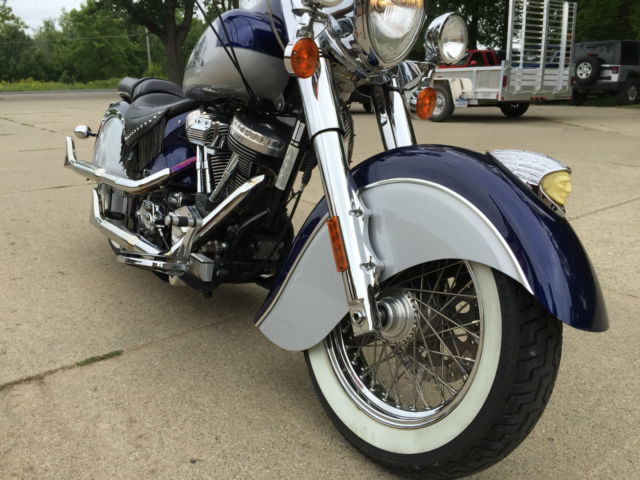
The 2002 Indian Chief stands as a testament to the renaissance of a legendary American cruiser brand, reviving a legacy that once dominated the open highways with its unmatched blend of heritage and performance. More than just a motorcycle, this model epitomizes a shift in motorcycling sensibilities—melding timeless design cues with modern engineering to captivate both nostalgic riders and a new generation of enthusiasts. Its re-emergence cues an era where classic American craftsmanship meets contemporary refinement, inviting curiosity and admiration in equal measure.
At first glance, the 2002 Indian Chief’s aesthetic is a visual ode to bygone decades. Cloaked in a stately Blue/Silver color scheme, the cruiser’s silhouette exudes an aura of authority and understated elegance. Every line is deliberate, drawing from Indian’s storied past yet executed with a finesse that resonates today. The broad fenders, flowing contours, and prominent tank insignia serve as hallmarks of the brand’s unmistakable identity—yet there’s a subtle modernity in its finish that conveys a deliberate evolution, not mere replication of past glories.
Delving beneath the surface reveals the beating heart of this cruiser: the Powerplus 100 V-twin engine. Renowned for its robust torque and dependable performance, it delivers a visceral riding experience crafted for both relaxed cruising and spirited acceleration. This powerplant is more than mechanical machinery; it is an emblem of American muscle and engineering prowess, harmonizing old-world charm with contemporary reliability. The engine roars to life with a commanding growl that reverberates down open roads, enchanting riders and passersby alike.
Ergonomically, the 2002 Indian Chief demands a consummate connection between rider and machine. Its seating position fosters an upright, commanding posture, a feature that amplifies comfort during long stretches while also enhancing road presence. The wide handlebars, spacious foot controls, and cushioned saddle collectively nurture an all-day rideability, speaking to an era when motorcycles were designed not just for adrenaline but endurance. This design nurtures a bond forged in tactile intimacy, encouraging exploration over shallow thrills.
One cannot overlook the craftsmanship that defines the 2002 Indian Chief’s exterior accoutrements. The chrome embellishments glint with a mirror-like sheen, punctuating the Blue/Silver palette with flashes of brilliance. This meticulous attention extends to details such as the intricate decals, sturdy yet stylish luggage supports, and the signature Indian head emblem gracing the front fender. Here, artistry and utility coalesce, rendering a motorcycle that looks as purposeful as it feels to ride.
Yet, what truly distinguishes the 2002 Indian Chief in a crowded cruiser landscape is its ability to evoke a profound sense of identity and history without succumbing to nostalgia’s trappings. It commands respect not merely because of its lineage, but through its conscious embrace of innovation. The chassis design incorporates modern metallurgy and suspension technologies to provide enhanced stability and handling, dispelling the myth that classic cruisers must be cumbersome or unresponsive. This balance between reverence and progressiveness challenges conventional perspectives on what an American cruiser can embody in the 21st century.
In an era marked by rapid technological advances and shifting consumer desires, the 2002 Indian Chief acts as a counterpoint—affirming that heritage brands possess a unique ability to adapt without diluting their core ethos. Its timeless design is not a static relic but a dynamic statement on the evolution of motorcycling culture. Observers may find themselves captivated by its visual poetry, yet riders discover depth beyond its surface, unveiling layers of engineering excellence and design intentionality.
The sonic signature of the Indian Chief further deepens the engagement. The throaty, rhythmic pulse of the V-twin is a symphony for enthusiasts attuned to the nuances of motor engine symphonies. It communicates not only power but personality, cultivating a rich, sensory experience that immerses the rider in a dialogue between man, machine, and environment. This auditory heritage echoes across highways and byways, perpetuating a narrative that transcends mere transport.
Moreover, the 2002 Indian Chief serves as a catalyst for re-evaluating the cruiser segment as a whole. Its reintroduction disrupts the prevailing market paradigms, where sportbikes and technologically laden machines often dominate consumer consciousness. Instead, it champions a philosophy of measured cruising, where presence, style, and mechanical integrity hold primacy. This invites a reconsideration of motorcycling values, nudging enthusiasts to appreciate tradition without forsaking sophistication.
The motorcycle’s adaptability extends beyond performance into the realm of customization and personal expression. The Indian Chief’s platform accommodates a broad spectrum of aftermarket modifications, enabling owners to tailor appearance, ergonomics, and mechanics to their preferences. This modularity fuels creativity and deepens attachment, transforming the motorcycle into a canvas for individual storytelling. Such versatility not only broadens appeal but underscores the model’s enduring relevance.
In essence, the 2002 Indian Chief embodies a confluence of past and future—a bridge between the historic reverence of American cruiser lineage and the practical demands of contemporary motorcycle ownership. It promises more than nostalgia; it offers a reinvigorated perspective, challenging riders to appreciate craftsmanship, performance, and design as an integrated whole. Its presence on the road ignites curiosity, prodding both veterans and novices to reconsider the possibilities inherent in the cruiser genre.
As the sun sets over open highways and city streets alike, the 2002 Indian Chief resonates as more than a machine. It is a narrative artifact, a rolling emblem of American motorcycling spirit renewed. For those willing to engage with it beyond its initial allure, this cruiser reveals an enriching journey—one that honors tradition while embracing innovation. It beckons riders to partake in a legacy reimagined, promising that the classic American cruiser’s story is far from finished, but rather, poised for a remarkable new chapter.