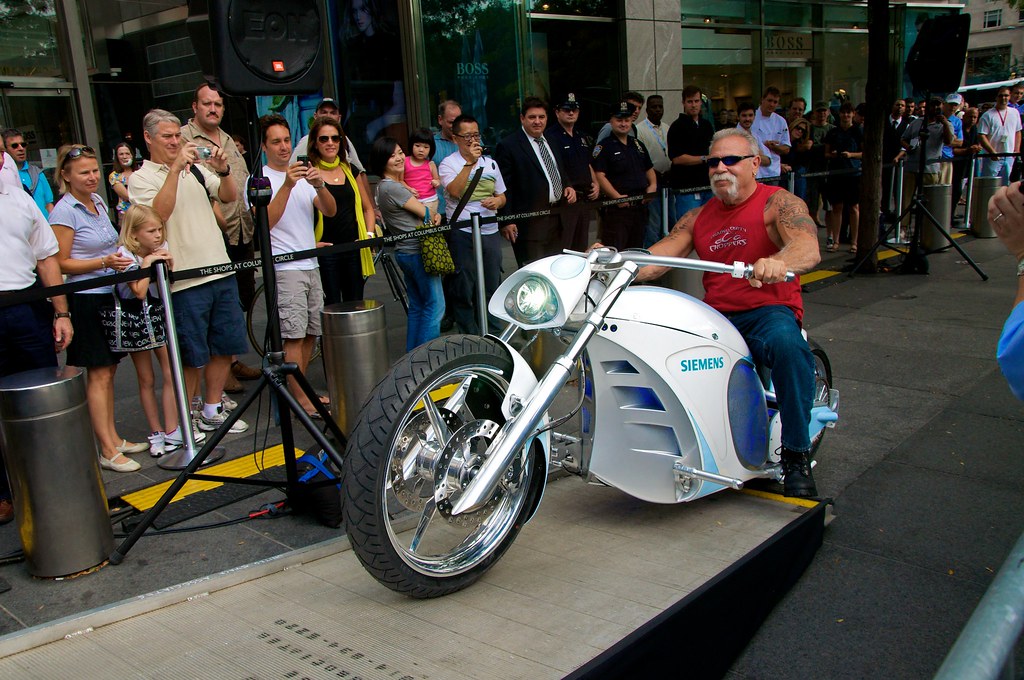
The Blue Bike is not merely a motorcycle—it is a rolling manifesto of craftsmanship, rebellion, and legacy. It is the mechanical embodiment of Paul Sr.’s vision, a steel-and-titanium poem etched into the asphalt of American motorcycle culture. More than a machine, it is a story told in chrome and paint, in the hum of its engine and the whisper of its exhaust. To understand the Blue Bike is to peer into the soul of Orange County Choppers, where every weld is a promise and every curve is a declaration of individuality. This is the chronicle of a machine that transcended its purpose to become a cultural icon.
The Genesis: A Dream Forged in Fire and Vision
In the crucible of the late 1990s, when the roar of Harley-Davidsons still echoed through the valleys of Orange County, a different kind of revolution was brewing. Paul Sr., a man whose name would soon become synonymous with innovation in the chopper world, envisioned a bike that would defy convention. The Blue Bike was not born from a blueprint alone—it emerged from a fever dream of possibility, where form followed function with the precision of a master sculptor. Its genesis was not in a sterile factory floor, but in the gritty, oil-stained sanctum of OCC’s workshop, where raw metal met raw ambition.
The choice of blue was no accident. In the language of color, blue is the hue of depth and mystery, of endless skies and hidden depths. It is the color of twilight, of the moment between day and night when the world is neither here nor there—but in transition. So too was the Blue Bike: a transitional masterpiece, bridging the gap between tradition and the avant-garde. Its cobalt frame was not just a canvas; it was a manifesto, a silent scream of “this is different” in a sea of black and chrome.

The Anatomy of a Legend: Engineering Poetry in Motion
To dissect the Blue Bike is to unravel a symphony of engineering brilliance. Its frame, a custom-welded lattice of chromoly steel, is a testament to structural artistry—each joint a calculated whisper of strength, each curve a deliberate dance with aerodynamics. The engine, a monstrous Twin Cam 103, is not just a powerplant; it is the heart of the beast, throbbing with the pulse of a thousand miles of open road. Its exhaust, a serpentine masterpiece of polished stainless, coils like a dragon’s tail, exhaling the fury of controlled combustion.
But the true magic lies in the details. The handlebars, sculpted from billet aluminum, curve like the wings of a predatory bird, ready to take flight at a moment’s notice. The seat, hand-stitched in supple leather, cradles the rider like a throne, while the footpegs, forged from titanium, offer a grip as firm as destiny itself. Even the smallest components—the bolts, the brackets, the hidden fasteners—are not mere afterthoughts but deliberate strokes in a larger canvas. The Blue Bike is not built; it is composed, each part a note in a mechanical sonata.
And then there is the color. That deep, mesmerizing blue—neither navy nor sky, but something in between, like the ocean at dusk. It is a color that demands attention, that shifts in the light, revealing hidden hues of violet and indigo. It is the color of royalty, of the deep sea, of the infinite. To ride the Blue Bike is to be draped in the mantle of legend, to become part of its mythos with every mile.
The Ride: A Symphony of Speed and Soul
To sit astride the Blue Bike is to become a pilgrim on the altar of two wheels. The moment the engine roars to life, the world narrows to a single point—the road ahead, the wind in your face, the thunder of the exhaust in your ears. There is no hesitation, no second-guessing. The Blue Bike does not ask permission; it demands surrender. It is a machine that does not merely transport—it transforms. Riders speak of a sensation that borders on the spiritual, as if the bike and rider merge into a single entity, a centaur of steel and spirit.
The handling is surgical. The suspension, finely tuned to the rider’s weight and style, absorbs the imperfections of the road with the grace of a ballerina. The brakes, a hydraulic marvel, bring the beast to a halt with the precision of a surgeon’s scalpel. And the acceleration—oh, the acceleration. It is not merely forward motion; it is a surge of pure, unadulterated power, a reminder that this machine was built to dominate, not to dawdle.
But the Blue Bike is more than a performance machine. It is a storyteller. Every twist of the throttle, every lean into a curve, is a chapter in a narrative that spans decades. It is the bike that Paul Sr. built for himself, not for the cameras or the accolades, but for the love of the craft. It is the bike that whispers of late nights in the garage, of grease-stained hands and the scent of burnt oil, of dreams that refused to stay on paper.
The Legacy: A Beacon for the Bold and the Unbroken
The Blue Bike is not just a relic of the past; it is a living, breathing testament to the enduring power of passion. It has inspired generations of builders, from backyard mechanics to professional fabricators, all of whom look to its design and engineering as a benchmark of excellence. It is a symbol of what happens when vision meets execution, when artistry meets mechanics, when a single machine becomes a cultural touchstone.
In an era where mass production churns out identical machines by the thousands, the Blue Bike stands as a defiant reminder of individuality. It is a declaration that true craftsmanship cannot be replicated by machines or algorithms. It is a call to arms for those who believe that a motorcycle should be as unique as the soul of its rider. To own a bike like the Blue Bike is to carry a torch—not just for the open road, but for the spirit of innovation that refuses to be tamed.
And so, the Blue Bike endures. It is more than steel and paint; it is a legacy. It is the bike that Paul Sr. built with his own hands, the bike that has ridden through the annals of motorcycle history, the bike that continues to inspire awe in those who behold it. It is a machine that does not merely exist—it lives, breathes, and roars, a testament to the power of human ingenuity and the unbreakable bond between man and machine.

The Mythos: Why the Blue Bike Captivates the Imagination
There is something almost mythological about the Blue Bike. It is not just a machine; it is a character in a larger saga, a protagonist in a story of ambition, rebellion, and unyielding passion. It is the bike that dared to be different in a world that often rewards conformity. It is the bike that turned heads, sparked conversations, and left an indelible mark on the landscape of motorcycle culture.
Part of its allure lies in its mystery. Unlike mass-produced motorcycles, the Blue Bike was not designed to appeal to the masses. It was built for one man—Paul Sr.—and in doing so, it became a reflection of his personality: bold, unapologetic, and endlessly creative. There is no corporate logo, no generic branding—just the raw, unfiltered essence of what it means to build a bike from the ground up, with nothing but vision and skill as guides.
It is also a bike that defies time. While trends come and go, the Blue Bike remains timeless. Its design is not bound by the whims of fashion; it is a classic in the truest sense, a machine that will never feel dated. It is the kind of bike that looks as stunning parked in a modern loft as it does rumbling down a desert highway at sunset.
And perhaps most importantly, the Blue Bike is a symbol of possibility. It reminds us that greatness is not the exclusive domain of the wealthy or the famous. It is a testament to what can be achieved with passion, perseverance, and a willingness to take risks. In a world that often feels constrained by rules and regulations, the Blue Bike is a rallying cry—a reminder that the road is there for the taking, and that the only limit is the one you impose on yourself.
The Future: A Legacy That Will Never Fade
The Blue Bike is more than a machine; it is a legacy that will outlive its creator. It is a piece of history, a work of art, and a symbol of what it means to chase a dream with unrelenting fervor. As long as there are riders who believe in the power of individuality, as long as there are builders who refuse to compromise on their vision, the spirit of the Blue Bike will endure.
It will inspire new generations of chopper builders, who will look to its design and engineering as a blueprint for their own creations. It will continue to captivate audiences, who will marvel at its beauty and power. And it will remain a touchstone for those who believe that a motorcycle should be more than just a means of transportation—it should be an extension of the soul.
So here’s to the Blue Bike—the machine that roared into legend and never looked back. May its story continue to inspire, its design continue to awe, and its spirit continue to burn bright, like the flame of a thousand engines, for generations to come.