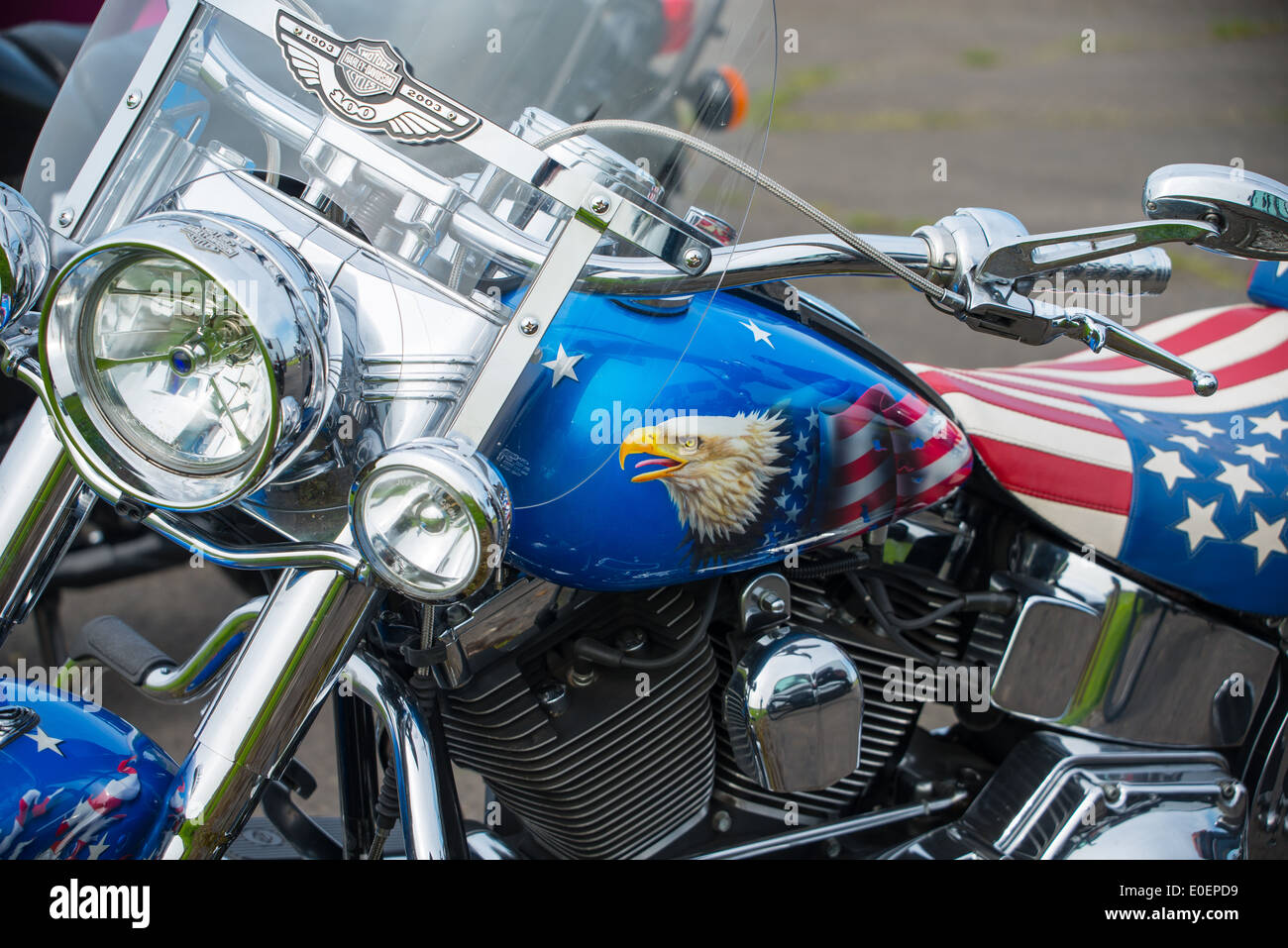
There’s something primal about a Harley-Davidson chopper—its raw, unfiltered spirit thrums like a heartbeat in the veins of the open road. But when that mechanical beast is draped in a coat of paint that’s equal parts artistry and rebellion, it ceases to be mere transportation. It becomes a rolling manifesto, a chromatic scream that echoes the rider’s soul. Custom Harley chopper paint jobs are not just about color; they are about crafting a visual symphony where every brushstroke, every metallic flake, and every intricate design choice tells a story of audacity, passion, and unbridled creativity. These are not machines. They are masterpieces on two wheels, each one a testament to the alchemy of metal and imagination.
The Canvas of Rebellion: Why Paint Jobs Define the Chopper Ethos
A chopper is more than a motorcycle—it’s a rebellion against convention, a middle finger to the assembly line, a declaration that the rider’s identity cannot be mass-produced. The paint job is the final, most visceral layer of this defiance. It’s where the mechanical grit of the engine meets the poetic flourish of the artist. Think of it as the difference between a factory-fresh Harley and one that’s been kissed by fire, then reborn in hues that defy gravity. The paint isn’t just applied; it’s *summoned*. It’s the difference between a whisper and a war cry, between a uniform and a signature.
Consider the way a flame job ripples across the tank like embers caught in a gust of wind, or how a candy apple red seems to glow from within, as if the bike itself is pulsing with life. These aren’t just colors—they’re incantations. They transform the chopper from a utilitarian object into a talisman, a piece of armor for the open road, a visual incantation that wards off the mundane and invites the extraordinary.
Fire and Fury: The Allure of Flame Paint Jobs
Few things in the world of custom paint evoke the same visceral thrill as a flame job. It’s as if the chopper has been plucked from the heart of a wildfire, its body still smoldering with the heat of creation. The flames aren’t just painted—they’re *animated*, leaping from the fenders like a predator in mid-strike, or curling around the frame in a dance of destruction and rebirth. The technique itself is a study in contrast: the deep blacks and charred oranges that form the base, the vibrant reds and yellows that lick upward like tongues of fire, and the metallic flakes that catch the light like embers in a forge.
What makes flame jobs so mesmerizing is their ability to make the motorcycle appear alive. A well-executed flame job doesn’t just sit there—it *moves*. The way the colors shift with the angle of the sun, the way the flames seem to flicker in the corner of your eye, the way the entire bike appears to writhe with energy—it’s hypnotic. It’s the visual equivalent of a growl, a warning to the world that this machine is not to be trifled with.

Candy-Coated Dreams: The Hypnotic Allure of Candy Paint
If flame jobs are the roar of a wildfire, candy paint jobs are the whisper of a summer sunset—rich, deep, and impossibly alluring. The term “candy” refers to a translucent layer of paint that’s applied over a metallic base, creating a depth that seems to glow from within. The effect is nothing short of alchemy: a color that shifts and shimmers as you move, as if the bike is made of liquid gemstone. Ruby reds, sapphire blues, emerald greens—these aren’t just colors; they’re portals to another world, a world where the motorcycle exists as a jewel rather than a machine.
The magic of candy paint lies in its layers. Each coat is a veil, a semi-transparent shroud that reveals glimpses of the metallic beneath. The result is a finish that seems to pulse with an inner light, as if the chopper is absorbing the very essence of the sun. It’s a look that demands attention, not just for its beauty, but for its audacity. To clad a chopper in candy paint is to declare that this machine is not just for riding—it’s for *adorning*, for turning heads, for making the pavement itself tremble with envy.
Tribal Tattoos on Steel: The Power of Custom Graphics
While flame and candy paint jobs dominate the visual landscape, the true rebels of the custom paint world are those who dare to go beyond color. Custom graphics—whether they’re intricate tribal patterns, surrealist landscapes, or even full-body murals—are where the chopper becomes a canvas for storytelling. These aren’t just decorations; they’re declarations. A chopper adorned with a dragon’s maw snarling from its gas tank isn’t just a motorcycle—it’s a mythic beast, a guardian of the road, a creature that exists in the space between reality and legend.
The appeal of custom graphics lies in their ability to transform the chopper into something deeply personal. A rider’s passions, fears, and dreams are etched into the metal, creating a machine that’s as unique as a fingerprint. Whether it’s a skull and roses motif that nods to classic biker culture, a celestial scene that evokes the vastness of the universe, or an abstract swirl of colors that defies interpretation, these designs are a conversation starter, a piece of art that moves with the rider, a silent testament to their journey.

Metallic Miracles: The Art of Mirror-Like Finishes
There’s something almost otherworldly about a chopper with a mirror-like metallic finish. It’s as if the bike has been forged in the heart of a neutron star, its surface so reflective that it seems to bend light itself. These finishes—often achieved with high-gloss clear coats and metallic flakes—turn the motorcycle into a moving mirror, a shard of the cosmos that reflects the world around it in distorted, dreamlike ways. A rider on such a machine doesn’t just traverse the road—they *command* it, their reflection rippling across the pavement like a mirage.
The allure of metallic finishes isn’t just in their shimmer; it’s in their impermanence. The way the reflections shift with the rider’s movement, the way the colors seem to change depending on the angle of the sun, the way the entire bike appears to dissolve into the landscape—it’s a reminder that this machine is alive, that it’s in constant dialogue with its surroundings. It’s a look that’s equal parts futuristic and primal, a fusion of technology and raw power that feels like something out of a sci-fi fever dream.
The Alchemy of Contrast: Black and Chrome Mastery
In a world of vibrant colors and flashy designs, the most striking paint jobs are often the simplest. A chopper clad in sleek black with accents of polished chrome is a study in contrast—light and dark, matte and reflective, shadow and illumination. The black serves as a void, a canvas that absorbs all other colors and makes the chrome pop like stars in a night sky. It’s a look that’s timeless, a nod to the classic biker aesthetic while remaining utterly modern.
What makes black and chrome so compelling is its versatility. It can be understated, a quiet declaration of power that speaks through subtlety rather than shouting. Or it can be bold, with chrome plating that gleams like liquid mercury, turning the chopper into a beacon of light in the dark. The interplay between the two creates a visual rhythm, a dance of opposites that feels both harmonious and electric. It’s a look that says, “I don’t need color to command attention—I am the color.”
Beyond the Brush: The Future of Custom Paint Jobs
The world of custom Harley chopper paint jobs is evolving, with artists pushing the boundaries of what’s possible. From hydrographics that wrap the entire bike in a seamless, photorealistic design to UV-reactive paints that shift color under sunlight, the future is a playground of innovation. There are choppers being painted with glow-in-the-dark pigments that come alive under the cover of night, and others adorned with holographic finishes that seem to defy physics. The only limit is the imagination of the artist—and the rider’s willingness to embrace the extraordinary.
As technology advances, so too does the artistry. 3D printing is being used to create custom stencils, airbrushing techniques are becoming more precise, and new materials are allowing for finishes that were once the stuff of fantasy. The chopper of tomorrow won’t just be a machine—it will be a living, breathing work of art, a fusion of steel and magic that blurs the line between reality and illusion. And for those who ride them, these machines will be more than transportation. They will be portals to another world, where the road is a stage and the bike is the star.