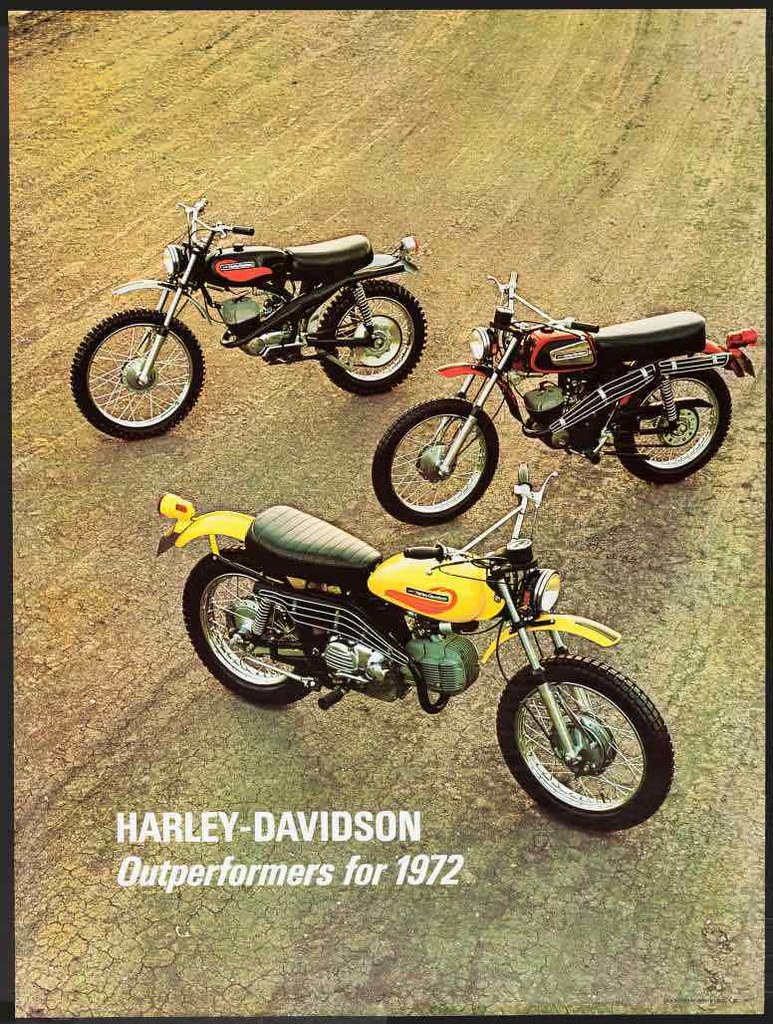
In the vast and variegated tapestry of motorcycle history, the 1970s stand as a pivotal decade—a time marked by innovation, rebellion, and the ceaseless quest for performance. Among the countless marques that defined an era, Harley-Davidson looms large, emblematic of American grit and the undying roar of a V-twin engine. Yet, amid the vivid panorama of choppers, cruisers, and touring rigs, an enigma persists: did Harley-Davidson truly forge dirt bikes in the 1970s, or are these machines merely phantoms birthed by enthusiasts’ imaginations and fragmented lore? The question invites a provocative reassessment of motorcycle heritage, challenging entrenched assumptions and shedding light on a nearly forgotten chapter of off-road motorcycling.
Harley-Davidson’s reputation is irrevocably intertwined with heavyweight cruisers, machines that epitomize the open road. Their disruption into the off-road domain isn’t a commonly heralded tale. Yet, whispers of Harley dirt bikes circulating through motorcycle circles hint at a tantalizing anomaly. Is it possible that amid the cultural revolution of the 1970s, when off-road motocross and enduro riding surged in popularity, Harley-Davidson attempted to seize a slice of this burgeoning market? To unravel this, one must immerse in the labyrinthine context of the period and examine whether such models were anything more than obscure prototypes, aftermarket conversions, or urban legends.
The 1970s bore witness to seismic shifts in motorcycling tastes. Japanese manufacturers—Honda, Yamaha, Suzuki, and Kawasaki—rapidly ascended with their agile, reliable, and affordable two-stroke dirt bikes, seizing a market segment they virtually redefined. European marques such as Bultaco and Maico also carved niches with their specialized off-road machines. Harley-Davidson, meanwhile, stood at a crossroads, grappling with financial instability and seeking avenues for revival. In such a climate, the idea of Harley-Davidson producing a dirt bike isn’t implausible; pragmatism could have driven experimentation in this domain.
Historical records, however, reveal a disparate narrative. Harley-Davidson is known to have produced light motorcycles under license agreements, including small-displacement models acquired from Italian and German craftsmen. The company’s involvement with these diminutive models suggests an awareness of non-cruiser markets, though not necessarily a wholehearted dive into dirt bike production. The crux lies in identifying dirt bikes that were truly designed and engineered by Harley-Davidson to compete in off-road conditions, rather than rebranded or modified iterations.
One candidate often cited in these discussions is the “Harley Chopper 125,” a diminutive off-road style motorcycle, but it doesn’t quite fit the archetype of a rugged motocross machine. Then there are the elusive images and references to the “Artofit” Harley dirt bike—a bespoke creation with an aesthetic steeped in 1970s off-road bravado, but whose provenance and production details remain shrouded in mystery. Are these relics remnants of a small-scale initiative, prototypes that never reached mass production, or custom artisans’ fantasies given tangible form?
The rarity of documented Harley dirt bikes suggests they were, at best, produced in very limited numbers or existed solely as experimental projects. Unlike their Japanese counterparts, Harley’s foray into off-roading was never punctuated by bold marketing campaigns or racing triumphs that could cement legitimacy within the dirt bike realm. This absence contributes to the mythos: machines that seem simultaneously real and spectral, capturing the imaginations of collectors and historians who yearn for a missing puzzle piece in Harley-Davidson’s storied legacy.
Delving deeper, the notion that these motorcycles are “rare” rather than mythical gains traction when considering the motorcycle subculture’s penchant for customization. It is plausible that passionate riders and fabricators retrofitted Harley engines into motocross frames or adapted traditional Harley chassis for trail riding, resulting in bespoke dirt bikes that bore the iconic bar and shield yet were never factory offerings. Such creations would sit precariously between myth and reality, blurring lines and fuelling speculation.
Moreover, Harley-Davidson’s strategic partnerships and technological exchanges complicate the narrative. The company’s acquisition of American Cycle’s manufacturing rights for smaller displacement motorcycles indicates that diversifying into off-road machines may have been considered, even if unrealized on a grand scale. The economic pressures and shifting market dynamics of the 1970s likely stymied such ventures before they could flourish.
Beyond pragmatics, the allure of a forgotten Harley dirt bike line resonates on a cultural level. It challenges the reductionist view of Harley-Davidson solely as an emblem of asphalt cruising, expanding the company’s identity to encompass a more eclectic and experimental spirit. This reimagining also invites enthusiasts and historians alike to question how histories are constructed and which narratives endure in the collective memory.
In the contemporary landscape, the intrigue surrounding these elusive machines persists. Some motorcycles bear the unmistakable Harley insignia yet are unmistakably dirt bike in form. Collectors treasure such oddities, while digital forums swarm with spirited debates about provenance and specifications. The ephemeral nature of these dirt bikes—rendered more conspicuous by their scarcity—imbues them with mystique, inviting enthusiasts to explore archives, auction catalogs, and anecdotal accounts in search of confirmation.
The saga of the 1970s Harley-Davidson dirt bikes ultimately resides in the interstice between rarity and myth, a liminal space that beckons further excavation. Whether these bikes were fleeting tangents in the company’s trajectory or enduring artifacts obscured by time, their story enriches the larger narrative tapestry of motorcycling heritage. By probing these shadowed corners, one gains not only a fresh perspective on Harley-Davidson’s versatility and ambition but also a profound appreciation for the intricate, often overlooked chapters that fill the annals of motorcycle history.
Thus, the enigma is far from resolved—it invites continued curiosity, rigorous scholarship, and perhaps serendipitous discovery. Forgotten 1970s Harley dirt bikes may straddle the borders of reality and myth, but their resonance endures, promising to shift perspectives and ignite the imagination of those who dare to traverse beyond the well-trodden highways of motorcycling lore.